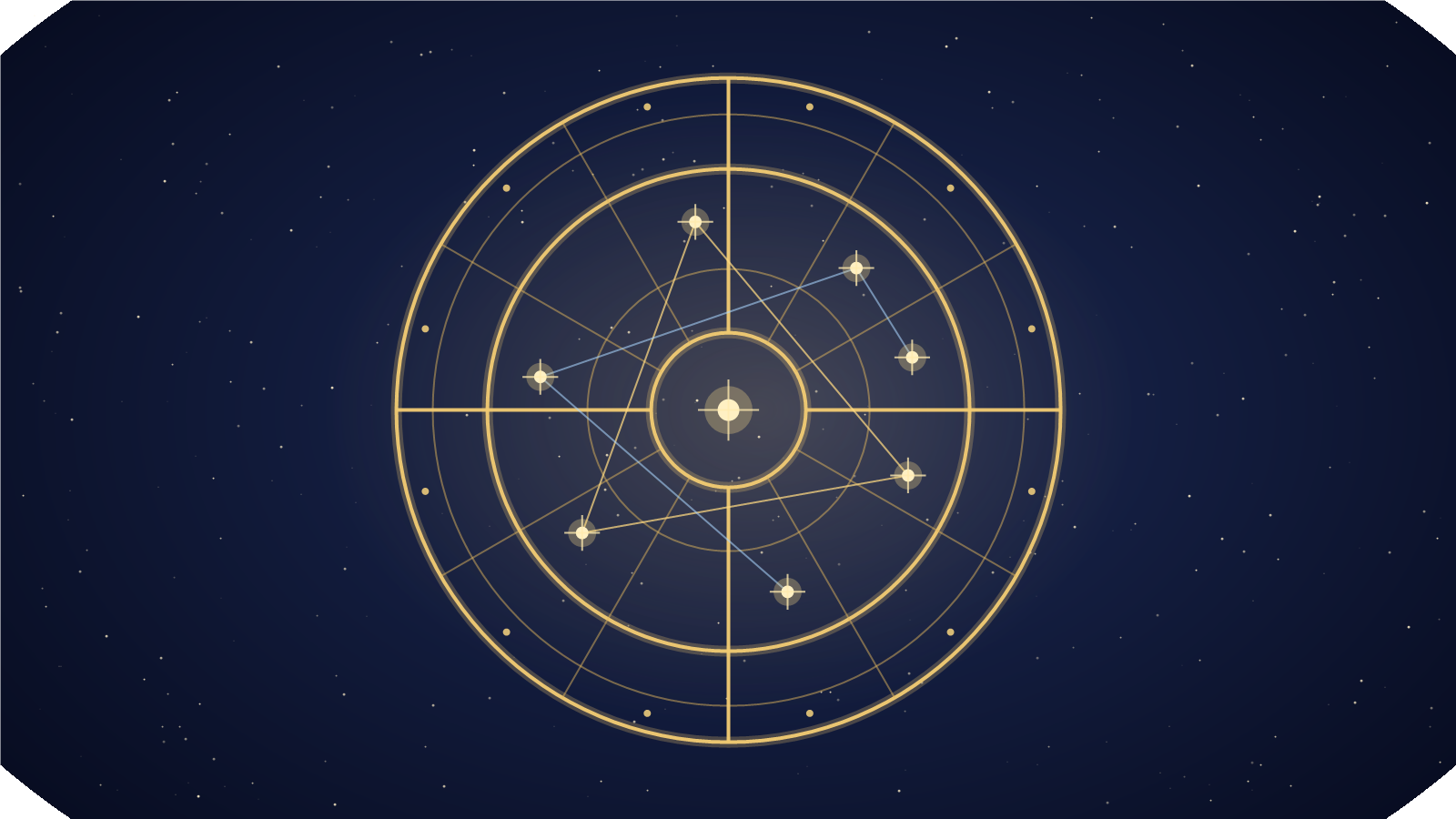
Opening your natal birth chart for the first time can feel like staring at an unfamiliar architectural blueprint covered in Greek glyphs, degree numbers, and intersecting colored lines. Yet once you separate the wheel into its four core layers, the entire diagram clicks into readable order. Rather than flattening human complexity into twelve newspaper Sun-sign horoscopes, a full birth chart maps dozens of interacting placements unique to your exact moment and place of arrival.
The cleanest way to learn chart interpretation is to treat astrology like grammar. Planets are the actors answering what psychological drive or function is operating; zodiac signs are the adverbs showing how each planet behaves; astrological houses are the stages showing where in daily life those themes play out; and aspects are the dialogue showing how different planets cooperate or challenge one another. Master those four building blocks sequentially, and you can read any chart wheel with confidence.
What a Natal Birth Chart Is Astronomically
Astronomically, a birth chart (traditionally called a nativity or horoscope, from the Greek horoskopos, meaning “hour-watcher”) is a two-dimensional, geocentric projection of the solar system photographed from your birthplace at the instant of birth. The outer circular ring represents the 360-degree ecliptic—the apparent annual pathway of the Sun across Earth’s sky, along which the Moon and major planets also travel within a narrow band.
In the Western Tropical Zodiac, that 360-degree circle is sliced into twelve strictly equal 30-degree sectors (each numbered from 0°00′ to 29°59′), anchored to 0° Aries at the Northern Hemisphere March Vernal Equinox. Understanding this seasonal coordinate system prevents a common point of confusion: tropical zodiac signs are not the same as astronomical constellations.
Actual star constellations defined by the International Astronomical Union vary wildly in ecliptic width—Virgo stretches roughly 44 degrees across the sky, whereas Scorpius occupies barely 7 degrees along the ecliptic path. Furthermore, because Earth’s rotational axis wobbles slowly over a ~25,772-year cycle (axial precession), the seasonal Vernal Equinox has drifted roughly 23 to 24 degrees westward relative to background stars over the past two millennia. Western tropical astrology tracks seasonal geometry, whereas Vedic Jyotish (Sidereal astrology) adjusts longitudes backward by an ayanamsa offset (commonly Lahiri) to align its twelve Rashis (Mesha through Meena) closer to the fixed stars.
The Four Essential Inputs and How Chart Calculators Work
Generating an accurate chart wheel requires four precise data points. Modern astrological engines—most built on the high-precision Swiss Ephemeris derived from NASA JPL planetary data—use these inputs to calculate exact planetary degrees and local horizon geometry:
- Birth Date: Establishes the zodiacal longitudes of the Sun, personal planets, and outer generational planets. Because the Moon travels roughly 12 to 15 degrees per day, even knowing the calendar date alone leaves the Moon’s sign uncertain on transition days without an approximate hour.
- Exact Birth Time (Hour and Minute): Earth rotates 360 degrees every 24 hours, pushing a new degree of the zodiac over the eastern horizon roughly every four minutes and shifting the Rising sign roughly every two hours. A fifteen-minute error can alter house cusps or move the Ascendant across a sign boundary.
- Birth Location (City, Latitude, and Longitude): Two babies born at the exact same minute in Tokyo and Toronto share identical planetary signs, yet their local horizons and overhead meridians differ completely—placing those planets into entirely different houses.
- Historical Time Zone and Daylight Saving Offset: Reputable calculators automatically cross-reference historical time-zone databases to convert local clock time into Coordinated Universal Time (UTC) before computing astronomical coordinates.
If you cannot locate a birth certificate or hospital record listing your exact time, you can still generate a noon chart to study your planetary signs and major planetary aspects accurately—simply disregard the Ascendant, Midheaven, and house placements, and double-check whether the Moon changed signs on your birth date.
Layer 1: The Planets, Luminaries, and Key Sensitive Points
Astrologers group the ten primary celestial bodies into three concentric speed tiers based on how quickly each body completes its circuit around the zodiac. Faster bodies define intimate, personal traits; slower bodies describe wider social frameworks and generational eras.
Beginners should start with the Luminaries (Sun and Moon) alongside the three inner Personal Planets (Mercury, Venus, and Mars). Together with the Rising sign, the Sun, Moon, and Ascendant form the backbone of individual temperament, while Mercury, Venus, and Mars govern communication, relational desire, and assertive drive. Next come the two Social Planets—Jupiter and Saturn—which connect personal aims to cultural norms, ethics, opportunity, and disciplined craft. Finally, the three modern Transpersonal (Outer) Planets—Uranus, Neptune, and Pluto—remain in a single zodiac sign for seven to thirty years, shaping collective cultural tides while acting intensely personally whenever they sit near a chart angle or tightly aspect a personal planet.
| Celestial Body | Tier | Approximate Orbit / Pace | Core Archetypal Function |
|---|---|---|---|
| Sun | Luminary | 1 year (~30 days/sign) | Core vitality, conscious purpose, creative identity, willpower |
| Moon | Luminary | ~27.3 days (~2.5 days/sign) | Emotional instincts, nervous-system safety, habits, memory |
| Mercury | Personal | ~88 days (within 28° of Sun) | Cognition, language, information processing, curiosity |
| Venus | Personal | ~225 days (within 47° of Sun) | Affection, aesthetic taste, social harmony, personal values |
| Mars | Personal | ~1.88 years (~6–7 weeks/sign) | Initiative, anger style, stamina, boundary defense, pursuit |
| Jupiter | Social | ~11.86 years (~1 year/sign) | Expansion, belief systems, mentorship, optimism, synthesis |
| Saturn | Social | ~29.45 years (~2.5 years/sign) | Structure, accountability, limits, mastery through time |
| Uranus | Outer | ~84 years (~7 years/sign) | Disruption, originality, sudden breakthroughs, autonomy |
| Neptune | Outer | ~165 years (~14 years/sign) | Imagination, spiritual longing, empathy, illusion, dissolution |
| Pluto | Outer | ~248 years (12–32 years/sign) | Deep transformation, power dynamics, psychological rebirth |
| Lunar Nodes | Points | ~18.6 years (retrograde) | North Node (growth stretch) & South Node (ingrained comfort) |
| Chiron | Centaur | ~50.7 years (eccentric orbit) | Core sensitivity, mentoring through lived vulnerability |
Notice an important astronomical detail in the table above: Mercury never strays farther than 28 degrees from the Sun (so your Mercury always sits in your Sun sign or an adjacent sign), and Venus never exceeds roughly 47 degrees from the Sun (limiting it to your Sun sign or within two signs on either side). Likewise, the Lunar Nodes are not physical planets—they are the mathematical intersection points where the Moon’s tilted orbital plane crosses the ecliptic, marking where solar and lunar eclipses occur.
Layer 2: The Twelve Zodiac Signs and Essential Dignities
Every planet sits inside one of the twelve zodiac signs, adopting that sign’s elemental temperament and modal pace. Because the four elements (Fire, Earth, Air, Water) and Cardinal, Fixed, and Mutable modalities combine into twelve unique expressions, Mars in Aries asserts itself rapidly and directly, whereas Mars in Cancer defends indirectly to shield emotional security.
Beyond basic sign flavors, classical Western astrology tracks Essential Dignities—a traditional framework describing how naturally a planet’s toolkit fits the environment of a given sign. Rather than labeling placements “good” or “bad,” think of dignities as resource availability: some signs hand a planet familiar tools immediately, while others push it to innovate under unfamiliar conditions.
- Domicile (Rulership): A planet occupies the sign it governs—like the Sun in Leo, Moon in Cancer, Venus in Taurus and Libra, Mercury in Gemini and Virgo, or Saturn in Capricorn and Aquarius (traditionally). The planet acts with clear autonomy and direct access to its native resources.
- Exaltation: A planet sits as an honored guest in a sign that elevates its highest qualities—such as the Sun in Aries, Moon in Taurus, Mercury in Virgo, Venus in Pisces, Mars in Capricorn, Jupiter in Cancer, and Saturn in Libra.
- Detriment (Exile): Directly opposite a planet’s domicile (for example, Venus in Aries or Scorpio, or Saturn in Cancer or Leo). The planet must translate its agenda into a foreign idiom, often fostering sharp self-awareness and unconventional strength over time.
- Fall (Depression): Directly opposite a planet’s exaltation (for instance, the Sun in Libra, Moon in Scorpio, Mars in Cancer, or Saturn in Aries). Planets in fall rarely operate on effortless autopilot; instead, they cultivate nuance, humility, and creative problem-solving through lived friction.
Layer 3: The Four Chart Angles and All Twelve Astrological Houses
While the zodiac signs rotate steadily through the sky over the course of a year, the twelve astrological houses rotate completely around Earth once every twenty-four hours. Houses tether cosmic symbolism to concrete earthly arenas—health, finances, siblings, career, marriage, and solitude.
The Four Cardinal Angles of the Wheel
Two perpendicular astronomical axes slice every birth chart into four quadrants, creating four high-voltage points called the Angles:
- Ascendant (AC / Rising Sign): The exact zodiac degree rising over the eastern horizon at birth (9 o’clock position on the wheel). It anchors physical presence, first impressions, life approach, and the sign whose planetary ruler steers the entire chart.
- Descendant (DC): Directly 180 degrees opposite the Ascendant on the western horizon (3 o’clock position). It reflects committed partnerships, one-to-one agreements, and traits we often meet through mirrors and significant others.
- Midheaven (MC / Medium Coeli): The highest point where the ecliptic intersects the local north-south meridian above the horizon (near 12 o’clock). It represents public reputation, vocation, visible legacy, and relationship with authority.
- Imum Coeli (IC / Bottom of the Sky): Directly opposite the Midheaven beneath the horizon (near 6 o’clock). It signifies private roots, ancestry, early home atmosphere, and psychological bedrock.
Angular, Succedent, and Cadent Houses
Just as signs divide into three modalities, the twelve houses group into three structural categories based on their proximity to the Angles. Angular houses (1st, 4th, 7th, 10th) hold peak visibility and outward action—planets placed here shape life headlines unmistakably. Succedent houses (2nd, 5th, 8th, 11th) follow each angle and govern resources, consolidation, and sustained investment. Cadent houses (3rd, 6th, 9th, 12th) fall away from the angles, emphasizing mental processing, daily service, travel, study, and unseen transition.
Complete Breakdown of Houses 1 Through 12
Classical Hellenistic astrology also assigned seven “Planetary Joys”—houses where each traditional planet feels uniquely aligned with the topic of the room. Reviewing all twelve houses side by side clarifies how planets shift tone depending on their room:
| House | Type | Core Life Arenas | Traditional Planetary Joy |
|---|---|---|---|
| 1st House | Angular | Selfhood, vitality, appearance, instinctive outlook, new beginnings | Mercury (helm of perception) |
| 2nd House | Succedent | Earned income, movable assets, material security, self-worth, practical skills | — |
| 3rd House | Cadent | Siblings, neighborhood, short travel, everyday communication, early schooling | Moon (daily rhythms & travel) |
| 4th House | Angular | Home, family lineage, real estate, private emotional roots, parents | — |
| 5th House | Succedent | Creative expression, romance, play, children, hobbies, joyful risk | Venus (pleasure & artistry) |
| 6th House | Cadent | Daily workflows, physical wellness routines, chores, pets, practical service | Mars (toil & problem-solving) |
| 7th House | Angular | Marriage, committed partnerships, business alliances, open rivals, contracts | — |
| 8th House | Succedent | Shared finances, inheritances, debt, psychological intimacy, grief & renewal | — |
| 9th House | Cadent | Higher education, long-distance travel, philosophy, publishing, law, belief | Sun (illumination & truth) |
| 10th House | Angular | Career trajectory, public honor, leadership, vocational milestones, mentors | — |
| 11th House | Succedent | Friendships, community networks, collective ideals, benefactors, future hopes | Jupiter (good spirit & allies) |
| 12th House | Cadent | Solitude, unconscious patterns, hidden strengths, retreat, institutions, closure | Saturn (seclusion & endurance) |
House Systems Fact-Check: Whole Sign vs. Placidus vs. Equal House
Few discoveries confuse astrology newcomers more quickly than generating their birth chart on two different websites and watching their Sun jump from the 10th house to the 11th house, or their Venus slide from the 7th into the 8th. Nothing broke in the calculation—the two platforms simply used different mathematical house systems to divide the space between the horizon and meridian.
- Whole Sign Houses: The primary system of ancient Hellenistic astrology (and widely revived by modern traditional astrologers). Whatever zodiac sign holds the Ascendant becomes the entire 1st house from 0° to 29°59′; the next sign is the 2nd house, and so on cleanly around the wheel. Whole Sign keeps every sign matched one-to-one with a house and allows the Midheaven degree to float naturally into the 9th, 10th, or 11th house.
- Placidus Houses: The default setting on most contemporary web calculators. Developed in the seventeenth century, Placidus is a time-based quadrant system that locks the Ascendant to the 1st house cusp and the Midheaven to the 10th house cusp, trisecting the time a degree takes to move between horizon and meridian. While nuanced near the equator and mid-latitudes, Placidus stretches houses dramatically at extreme northern or southern latitudes (above ~60°), producing intercepted signs where an entire zodiac sign sits swallowed inside one oversized house.
- Equal House System: Starts at the exact degree of the Ascendant (for instance, 16° Leo) and marks every subsequent house cusp exactly 30 degrees ahead (16° Virgo for the 2nd house, 16° Libra for the 3rd). Like Whole Sign, it avoids distorted house widths at high latitudes while keeping the Midheaven independent of the 10th cusp.
Rather than hunting for one “correct” system right away, compare Whole Sign and Placidus against real events in your biography. Notice which placement resonates more accurately with your lived experience of career, family, and partnerships, and stick consistently to that house system as you deepen your study.
Layer 4: Planetary Aspects, Orbs, Stelliums, and Empty Houses
Those crisscrossing colored lines inside the center of a chart wheel represent aspects—exact geometric angles measured along the 360-degree ecliptic between two planets or sensitive angles. Planets rarely hit exact angles to the arcminute, so astrologers apply an allowable margin of error called an orb. Tighter orbs (0° to 3°) operate loudly and unmistakably throughout life; wider orbs (6° to 8°) murmur softly in the background. Astrologers also distinguish applying aspects (where the faster planet is moving toward exactness, building momentum) from separating aspects (where exactness has already passed, diffusing gradually).
| Major Aspect | Angle | Typical Orb | Symbolic Relationship |
|---|---|---|---|
| Conjunction | 0° | 6°–8° (up to 10° with Sun/Moon) | Fusion and intensity; two planets merge agendas into one unified force |
| Sextile | 60° | 4°–6° | Opportunity and dialogue; compatible elements requiring conscious activation |
| Square | 90° | 6°–8° | Friction and catalytic action; same-modality tension demanding decisive growth |
| Trine | 120° | 6°–8° | Flow and natural talent; shared-element ease that can occasionally foster complacency |
| Opposition | 180° | 6°–8° (up to 10° with Sun/Moon) | Polarity and awareness; tug-of-war seeking balance, often experienced via others |
Demystifying Stelliums and Empty Houses
Two chart features regularly trigger unnecessary anxiety among beginners: crowded rooms and empty rooms.
A stellium occurs when three or more personal planets (or four or more planets including slower bodies) cluster tightly within a single zodiac sign or astrological house. Far from conferring automatic destiny or overwhelm, a stellium simply acts like a spotlight—concentrating disproportionate life energy, talent, and recurring lessons into one unmistakable theme. Whenever a slow transiting planet crosses a stellium, multiple dimensions of life shift simultaneously.
Equally misunderstood are empty houses. Because Western charts map ten major planets across twelve houses, every single person on Earth has at least two empty houses—and many charts have five or six. An empty 7th house does not foretell lifelong solitude, an empty 2nd house does not mean financial scarcity, and an empty 10th house does not preclude vocational acclaim. Empty houses simply operate with fewer internal complications. To read an empty house accurately, look at the zodiac sign sitting on its cusp, locate that sign’s ruling planet elsewhere in the chart, and trace how that ruler connects the empty house’s topics to active areas of your life. For example, an empty 7th house with Libra on the cusp is steered by Venus—so wherever Venus sits by sign, house, and aspect describes how partnerships unfold.
A Complete 6-Step Walkthrough to Read Your Birth Chart From Scratch
Staring at twenty placements simultaneously creates analysis paralysis. Use this repeatable six-step sequence to build a grounded, coherent reading from the ground up:
- Step 1 — Anchor the Big Three and the Chart Ruler: Record your Sun sign and house (core vitality), Moon sign and house (emotional needs), and Ascendant sign (interface with the world). Then identify your Chart Ruler—the planet governing your Rising sign (for example, Mars for Aries Rising, Venus for Taurus Rising, Mercury for Gemini Rising). Its house placement reveals the central life arena steering your overall trajectory.
- Step 2 — Tally Elemental and Modal Signatures: Count how many personal planets and angles occupy Fire, Earth, Air, and Water, and how many occupy Cardinal, Fixed, and Mutable signs. Dominant elements highlight instinctive coping styles, while scarce elements mark skills developed consciously.
- Step 3 — Read Mercury, Venus, and Mars for Everyday Patterns: Map how you process dialogue and study (Mercury), what builds intimacy and relational harmony (Venus), and how you pursue goals or handle conflict and communication (Mars).
- Step 4 — Isolate the Tightest Aspects (0°–3° Orb): Before memorizing every faint line on the wheel, circle the three or four tightest aspects—especially any contacting the Sun, Moon, Ascendant, or Midheaven. These exact geometric links explain internal contradictions far better than isolated sign descriptions.
- Step 5 — Contextualize Jupiter, Saturn, and the Outer Planets by House: Notice where Jupiter encourages growth and where Saturn asks for steady craftsmanship. For Uranus, Neptune, and Pluto, focus primarily on their house placement and any tight aspects to your personal planets rather than their generational sign alone.
- Step 6 — Synthesize Into Plain-English Sentences: Combine Planet + Sign + House + Major Aspect into a single grounded statement. For instance: Venus (values and affection) in Capricorn (pragmatic, loyal, status-aware) in the 10th house (career and public standing) forming a trine to the Moon in Taurus in the 2nd house (steady material comfort) translates cleanly as someone who builds lasting professional alliances with warmth, favors dependable long-term partners over fleeting drama, and feels emotionally grounded when creative or relational commitments support tangible security.
Frequently Asked Questions About Reading a Birth Chart
Am I born “on the cusp” between two zodiac signs?
Astronomically, the Sun can occupy only one exact degree and arcminute at the instant of birth—it is never split across two signs simultaneously. People born near calendar transition dates (such as April 19–20 or September 22–23) often feel traits of the neighboring sign not because their Sun is a hybrid, but because Mercury or Venus frequently sits in that adjacent sign, or because leap years shift the exact hour of solar ingress slightly each year.
What does it mean if a planet is retrograde in my natal birth chart?
Retrograde motion is an optical illusion from Earth’s vantage point caused by differences in orbital speed as planets pass one another. Symbolically, a natal retrograde planet directs its energy inward first—encouraging reflection, revision, and unconventional approaches before outward expression. Roughly forty percent of the population has outer planets retrograde, and natal Mercury, Venus, or Mars retrogrades simply signal a reflective, non-linear style rather than bad fortune.
Why do I relate more to my Moon or Rising sign than my Sun sign?
Several chart factors can overshadow a Sun sign: a nocturnal chart (being born at night, when classical astrology designates the Moon as the primary sect luminary), a stellium of personal planets clustered in another sign, or a Sun sitting in a cadent house like the 12th while the Moon sits prominently on an Angle. In addition, the Ascendant shapes immediate social instincts, making Rising traits instantly recognizable to friends and coworkers.
What is the difference between a Day Chart and a Night Chart (Sect)?
In traditional Hellenistic astrology, checking whether the Sun sits above the horizon line (houses 7 through 12 = Day Chart) or below the horizon line (houses 1 through 6 = Night Chart) establishes Sect. In daytime charts, the Sun, Jupiter, and Saturn align with the diurnal team; in nighttime charts, the Moon, Venus, and Mars align with the nocturnal team—subtly modulating how constructively Saturn or Mars operates in your chart.
Does my natal birth chart change as I get older?
No—your natal chart remains permanently fixed as the sky snapshot of your birth. What shifts over time are predictive and timing layers laid on top of it: current planetary transits moving across your natal degrees, secondary progressions (symbolically equating one day after birth with one year of life), and annual profections (activating a new house and its planetary ruler each birthday).
Why do identical twins sometimes display different personalities despite nearly identical charts?
Even a five-to-fifteen-minute delivery gap shifts the Ascendant and house cusps by 1° to 4°, occasionally moving an angle across a sign boundary or tightening a planet’s proximity to an Angle. Just as importantly, astrology reflects symbolic archetypal potentials rather than rigid scripts: siblings actively differentiate roles within a family system, expressing different facets of the same planetary configuration.
Do specific degree numbers like 0° or 29° hold special significance?
Traditional and modern astrologers often note planets placed at 0° (the fresh, raw threshold of a sign) or 29° (the anaretic or final degree, carrying urgency and culmination). While interesting nuances, degree symbolism always remains secondary to sign, house, planetary ruler, and tight aspects—never let a single degree number override the broader chart context.
How long does it take to read a birth chart accurately without relying on apps?
With steady practice—studying your own wheel alongside five or six charts of consenting family members and close friends—most learners grasp the four core layers comfortably within two to three months. Start by practicing plain-English translations of Planet + Sign + House before layering on minor aspects, asteroids, or advanced timing techniques.
Note on Astrology: Western astrology is a historical, cultural, and symbolic interpretive tradition intended for self-reflection and creative insight. It is not a substitute for empirical science or licensed medical, mental-health, legal, or financial advice.

[…] them an overwhelmingly Cardinal chart signature. To assess modal balance accurately when reading a birth chart, tally the modalities of all ten classical and modern planets along with the Ascendant and […]
[…] beginners start learning how to read a birth chart, they usually treat planets and zodiac signs like simple interchangeable labels: a planet supplies […]