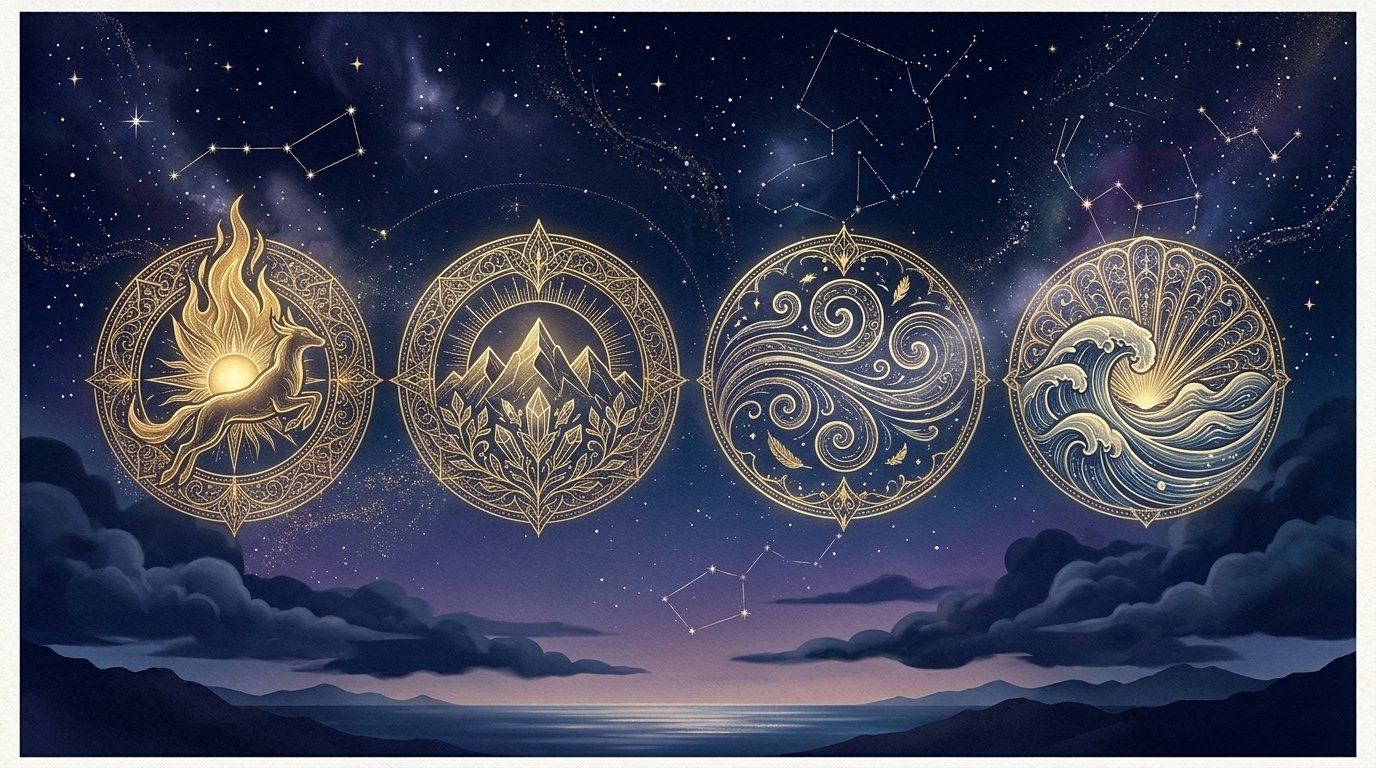
Every zodiac sign in Western astrology is built from two intersecting coordinates: a modality (how energy moves through time) and an element (what kind of fuel powers that movement). If the Cardinal, Fixed, and Mutable modalities set the tempo of a musical piece, the four classical elements—Fire, Earth, Air, and Water—supply the instruments themselves. Learn how those four elemental languages operate, and the twelve signs stop feeling like arbitrary personality stereotypes and snap into a clean, memorable grammar.
Whether you are just learning how to read your birth chart or refining years of study, elemental balance often explains more about a person’s daily temperament than any isolated planetary aspect. Two charts can contain identical Sun signs yet inhabit completely different emotional worlds if one chart leans heavily toward Fire and Air while the other pools deeply in Earth and Water.
All elemental assignments below follow the Western Tropical Zodiac, a seasonal coordinate system anchored to 0° Aries at the Northern Hemisphere Vernal Equinox rather than to the physical star constellations shifted roughly 23° to 24° by axial precession or the sidereal Rashi framework of Vedic Jyotisha.
Historical Roots of the Four Classical Elements
The astrological elements did not begin as poetic metaphors invented by modern magazines. They emerged directly from ancient Mediterranean natural philosophy, classical medicine, and Hellenistic mathematical astronomy across nearly seven centuries of intellectual refinement.
In the fifth century BCE, the Sicilian Greek philosopher Empedocles of Acragas proposed that all observable matter arises from four eternal, irreducible rhizomata (“roots”): Fire, Air, Water, and Earth. Rather than vanishing or appearing out of nothing, Empedocles argued, these four roots continually combine and separate under two opposing cosmic principles—Philia (Love, drawing unlike things together) and Neikos (Strife, pulling compounds apart).
A century later, Aristotle revolutionized Empedocles’ model in On Generation and Corruption by anchoring the four elements to two sensory axes of primary qualities: Hot versus Cold (active qualities that heat, cool, or energize) and Dry versus Wet (passive qualities that bind, separate, or yield). Under Aristotle’s geometric square, each element occupies a distinct pair of qualities: Fire is Hot and Dry, Earth is Cold and Dry, Air is Hot and Wet, and Water is Cold and Wet. Because adjacent elements share one quality, matter could transform smoothly along the wheel—Water evaporating into Air when Cold warms to Hot while retaining moisture.
Physicians in the Hippocratic and Galenic traditions quickly mapped Aristotle’s qualities onto human physiology through the four humors and classical temperaments: Fire corresponded to yellow bile and the brisk Choleric disposition; Earth to black bile and the reflective Melancholic constitution; Air to blood and the sociable Sanguine temperament; and Water to phlegm and the steady Phlegmatic nature. Although modern medicine retired humoral theory centuries ago, its psychological vocabulary survived directly inside Western astrology.
Finally, Hellenistic astrologers—most famously Claudius Ptolemy in his second-century CE treatise Tetrabiblos alongside earlier authors such as Dorotheus of Sidon—codified the zodiac’s four geometric triplicities (trigonoi). Connecting signs spaced 120° apart (the harmonious trine aspect) produced four equilateral triangles around the ecliptic wheel. Ptolemy paired Fire and Air as diurnal (active, expressive) triplicities and Earth and Water as nocturnal (receptive, inward) triplicities, while earlier Dorothean practice assigned dedicated day, night, and participating planetary rulers to each triangle (for example, the Fire triplicity governed by the Sun by day, Jupiter by night, and Saturn as co-ruler).
Master Comparison of the Four Astrological Elements
Viewing all four elements side by side clarifies how classical qualities translate directly into recognizable behavioral patterns.
| Element | Polarity / Sect | Classical Qualities | Signs (Cardinal / Fixed / Mutable) | Classical Temperament | Core Drive | Shadow Tendency |
|---|---|---|---|---|---|---|
| Fire | Active / Diurnal | Hot & Dry | Aries / Leo / Sagittarius | Choleric | Ignition, self-expression, lived meaning | Burnout, impulsivity, overlooking nuance |
| Earth | Receptive / Nocturnal | Cold & Dry | Capricorn / Taurus / Virgo | Melancholic | Durability, craftsmanship, tangible stewardship | Rigidity, overwork, fear of disruption |
| Air | Active / Diurnal | Hot & Wet | Libra / Aquarius / Gemini | Sanguine | Inquiry, pattern-making, social exchange | Detachment, overthinking, disembodiment |
| Water | Receptive / Nocturnal | Cold & Wet | Cancer / Scorpio / Pisces | Phlegmatic | Emotional resonance, protection, depth | Overwhelm, porous boundaries, withdrawal |
Notice an overlooked classical insight hiding inside the “Classical Qualities” column: Dryness versus Wetness. Dry elements (Fire and Earth) draw crisp edges around selfhood—Fire asserts individual will, while Earth guards concrete boundaries and resources. Wet elements (Air and Water) dissolve barriers to connect—Air bridges minds across ideas and dialogue, while Water merges feelings across empathy and shared memory. Pairing Active/Receptive with Dry/Wet explains immediately why Fire and Earth share rugged self-reliance despite very different speeds, and why Air and Water both excel at relational attunement despite living in head versus heart.
Fire Signs (Aries, Leo, Sagittarius): Ignition, Radiance, and Vision
Hot and Dry, Fire is the element of catalytic vitality, creative daring, and unscripted momentum. Fire energy rarely waits for external permission before testing an idea; it learns by stepping into the arena, taking heat, and adjusting course on the fly. Where Fire concentrates in a natal chart, life demands room for candid enthusiasm, risk, and personal authorship.
Yet the three Fire signs burn with unmistakably distinct flames:
- Aries (Cardinal Fire, ruled by Mars): The match-strike and pioneer spark. Aries Fire erupts instantaneously to break deadlocks, test limits, and champion direct action. It thrives on fresh contests rather than prolonged maintenance, valuing candor over ceremony.
- Leo (Fixed Fire, ruled by the Sun): The steady hearth and midsummer sun. Unlike Aries’ sprint, Leo sustains warmth over decades through creative pride, loyal generosity, and dignified stewardship. Leo Fire seeks to radiate—turning ordinary rooms into memorable stages where everyone feels larger.
- Sagittarius (Mutable Fire, ruled by Jupiter): The traveling torch and philosophical beacon. Sagittarius directs Fire outward toward distant horizons, humor, ethics, and big-picture synthesis. Its flame stays brightest when questioning dogmas and chasing lived wisdom across unfamiliar terrain.
In imbalance, excessive Fire scorches its own fuel supply—confusing constant urgency with genuine progress, talking past quieter teammates, or abandoning promising projects the instant tedious logistics begin.
Earth Signs (Taurus, Virgo, Capricorn): Form, Craft, and Endurance
Cold and Dry, Earth translates raw inspiration into things you can hold, inhabit, eat, budget, and rely on five winters from now. Earth energy trusts verifiable evidence over grand promises. It notices texture, temperature, structural integrity, and time horizons, turning fleeting opportunities into durable foundations.
Inside the Earth triplicity, each sign shapes physical reality differently:
- Taurus (Fixed Earth, ruled by Venus): Rich orchard soil. Taurus values tactile enjoyment, aesthetic craftsmanship, unhurried rhythm, and material peace. It builds slowly, guards what nourishes life, and refuses to be stampeded by artificial urgency.
- Virgo (Mutable Earth, ruled by Mercury): Sifted grain and artisan workshop. Virgo approaches matter analytically—diagnosing flaws, refining workflows, cultivating bodily wellness, and improving everyday tools until function and grace align cleanly.
- Capricorn (Cardinal Earth, ruled by Saturn): Bedrock and alpine architecture. Capricorn treats time itself as a building material, climbing patiently toward institutional competence, lasting reputation, and self-sufficient mastery even under lean conditions.
Earth’s shadow emerges when prudence hardens into stubborn pessimism—clinging to outgrown routines purely because they feel predictable, equating self-worth with measurable productivity, or dismissing intuition because it cannot yet fit inside a spreadsheet.
Air Signs (Gemini, Libra, Aquarius): Inquiry, Proportion, and Systems
Hot and Wet, Air circulates across minds, languages, and social networks, transforming solitary experience into shared meaning. Air signs excel at stepping half a pace back from raw emotion so they can map connections, compare perspectives, invent fairer agreements, and articulate what everyone else vaguely sensed without finding the words.
Each Air sign moves through intellectual space on a different current:
- Gemini (Mutable Air, ruled by Mercury): A playful cross-breeze darting between neighborhoods. Gemini gathers observations rapidly, cross-pollinates unrelated disciplines, translates complex jargon into witty speech, and thrives on nimble curiosity.
- Libra (Cardinal Air, ruled by Venus): Balanced atmosphere and clean proportion. Libra applies analytical clarity directly to human pairings, aesthetics, and ethics—weighing competing claims gracefully to restore reciprocity and visual harmony.
- Aquarius (Fixed Air, traditionally Saturn; modern co-ruler Uranus): High-altitude jet stream. Aquarius holds steadfast intellectual convictions, examining institutions from an outsider’s vantage to redesign outdated social structures around collective principle and personal autonomy.
When overplayed, Air floats too far above physical life—substituting clever debate for embodied action, analyzing feelings from afar instead of actually feeling them, or scattering attention across twenty open browser tabs without landing on one commitment.
Water Signs (Cancer, Scorpio, Pisces): Memory, Depth, and Resonance
Cold and Wet, Water navigates life through somatic intuition, emotional memory, unspoken undercurrents, and protective devotion. Water knows immediately when a cheerful room hides quiet grief or when a polished contract conceals bad faith. Where Water gathers in a chart, authentic safety, imaginative depth, and soulful bonds take priority over surface polish.
Water manifests in three starkly contrasting bodies across the zodiac:
- Cancer (Cardinal Water, ruled by the Moon): Sheltered tidal cove and nourishing spring. Cancer actively constructs emotional sanctuaries—protecting chosen family, honoring lineage, and anticipating unspoken physical or emotional needs before anyone asks.
- Scorpio (Fixed Water, traditionally Mars; modern co-ruler Pluto): Deep subterranean well and still fjord. Scorpio channels Water into concentrated, unwavering intensity—penetrating taboos, staying calm during crises, guarding fierce loyalty, and transforming pain into strategic resilience.
- Pisces (Mutable Water, traditionally Jupiter; modern co-ruler Neptune): Boundless open sea. Pisces dissolves rigid separations between self and environment, fueling artistic synthesis, compassionate forgiveness, dreamlike symbolism, and quiet spiritual receptivity.
Water’s recurring challenge is boundary clarity: absorbing other people’s unexpressed stress as personal obligation, retreating behind silent resentment instead of voicing plain requests, or letting yesterday’s emotional bruises dictate today’s choices.
How to Tally Your Personal Elemental Balance
One of the biggest breakthroughs in natal chart reading happens when you stop equating your elemental identity solely with your Sun sign. Someone born with an Aries Sun (Fire) can easily hold a Taurus Moon, Taurus Rising, Pisces Mercury, Pisces Venus, and Capricorn Mars—producing a profoundly grounded, reflective Earth-and-Water personality with only a single spark of Fire. Checking your Sun, Moon, and Rising signs alongside your personal planets reveals the true climate of your chart.
Because fast-moving lights and chart angles shape daily personality far more personally than slow generational planets, most astrologers use a weighted scoring method rather than counting every object equally:
| Natal Placement | Suggested Weight | Why This Weight Applies |
|---|---|---|
| Sun, Moon, and Ascendant (Rising) | 3 points each (9 pts total) | Anchor conscious vitality, emotional regulation, and overall life orientation |
| Mercury, Venus, and Mars | 2 points each (6 pts total) | Govern everyday speech, relational taste, desire, and conflict style |
| Jupiter and Saturn | 1 point each (2 pts total) | Shape broader growth patterns, ethics, and structural commitments |
| Uranus, Neptune, and Pluto | 0 points (optional +1 only if tightly on an angle or Sun/Moon) | Spend 7 to 30 years in a single sign, reflecting shared generational eras rather than individual temperament |
Add up the points for each element across this 17-point scale. A balanced distribution typically places 3 to 5 points in every element, allowing flexible shifts between action, planning, analysis, and empathy. A score of 7 or more points marks a dominant element that colors nearly every life arena, whereas 0 or 1 point signals an underrepresented or missing element.
A quick worked example shows why this tally outperforms Sun-sign guesswork. Imagine a chart containing an Aries Sun (3 Fire), Capricorn Moon (3 Earth), Virgo Rising (3 Earth), Pisces Mercury (2 Water), Taurus Venus (2 Earth), Scorpio Mars (2 Water), Cancer Jupiter (1 Water), and Capricorn Saturn (1 Earth). The totals come to 9 Earth, 5 Water, 3 Fire, and 0 Air. Despite carrying a fiery Aries Sun, this person moves through everyday work and intimacy predominantly through steady Earth craftsmanship and deep Water intuition, while consciously leaning on written frameworks or analytical peers to supply the missing Air perspective.
Dominant vs. Missing Elements: Strength, Overuse, and Conscious Growth
Beginners frequently panic upon discovering zero placements in Earth or Water, worrying that their chart labels them permanently scattered or cold. Traditional and psychological astrologers alike reject that fatalistic reading. In practice, both elemental excess and elemental absence carry distinct gifts and blind spots.
A dominant element operates like native fluency—you solve problems through it effortlessly without thinking twice. Yet every super-skill tempts overuse. A Fire-heavy chart tries to blast through grief with sheer willpower; an Air-heavy chart attempts to debate away physical exhaustion; a Water-heavy chart reads deep emotional subtext into routine administrative emails.
An underrepresented or missing element, conversely, is never a character defect. As twentieth-century astrological author Stephen Arroyo observed—echoing Carl Jung’s work on the “inferior function”—people with a minimal element often become fascinated by it. Because that elemental mode does not run on autopilot, they frequently cultivate it deliberately through chosen professions, mentors, partners, or disciplined personal habits—sometimes developing extraordinary conscious skill precisely where their natal chart looks bare.
Practical, grounded habits help bring an under-resourced element into everyday rotation:
- Low or Missing Fire: Schedule regular physical movement, unmonitored creative play, and small low-stakes dares so vitality stays warm rather than deferring endlessly to caution or consensus.
- Low or Missing Earth: Anchor abstract ambitions with simple tactile rituals—automated savings transfers, written checklists, cooking real food from scratch, and spending unhurried minutes outdoors.
- Low or Missing Air: Build deliberate pause points before reacting emotionally—journaling problems on paper, consulting an impartial sounding board, and naming patterns calmly before deciding.
- Low or Missing Water: Protect unscheduled quiet time free of screens and performance metrics, noticing physical fatigue and gut impressions rather than overriding feelings purely with logic or duty.
Elemental Dynamics in Teamwork, Creativity, and Relationships
Comparing elemental profiles across two people—whether romantic partners, business co-founders, or creative collaborators—explains chemistry and recurring friction faster than almost any other shorthand tool.
In group settings such as design studios, leadership teams, or multi-generational households, healthy momentum relies on all four elemental voices holding a seat at the table. Fire pitches the audacious goal and rallies morale when enthusiasm dips; Air stress-tests logic, drafts clear agreements, and spots emerging trends; Earth safeguards budgets, supply chains, and realistic timelines; and Water monitors unspoken team fatigue, preserves institutional trust, and ensures the human purpose behind the work never erodes. When an entire group clusters inside one element, blind spots multiply rapidly—making elemental diversity a quiet competitive advantage.
Same-Polarity Partnerships (Easy Flow): Fire and Air form an exhilarating, oxygen-fed alliance; Air supplies inventive concepts while Fire ignites bold execution. Their shared risk is accelerating past practical budgets or emotional check-ins. Earth and Water create a deeply restorative partnership—Water brings intuitive loyalty and imaginative care while Earth constructs a reliable shelter where feelings stay safe. Their shared pitfall is lingering too long inside comfortable ruts once circumstances demand bold reinvention.
Contrasting-Polarity Partnerships (Creative Friction): Pairings that mix active and receptive elements generate sharper learning curves alongside remarkable durability when mutual respect holds:
- Fire + Water (Steam): Magnetically passionate and artistically vivid, yet vulnerable to accidental injury—Fire’s blunt honesty can bruise Water, while Water’s indirect moodiness can dampen Fire’s confidence unless both communicate expectations plainly.
- Earth + Air (Blueprint Meets Concrete): Air spots clever efficiencies and future concepts, while Earth tests whether those blueprints survive real-world constraints. Together they produce brilliant engineering, writing, and business operations—provided Air respects deadlines and Earth tolerates brainstorming detours.
- Fire + Earth (The Kiln): Fire supplies visionary courage and Earth contributes patient endurance. When balanced, this pair builds enduring landmarks; when misaligned, Fire feels micromanaged and Earth feels dragged into reckless bets.
- Air + Water (Mist and Metaphor): Air gives crisp articulate form to Water’s unspoken intuition, creating extraordinary therapists, lyricists, and compassionate communicators once Air stops dismissing feelings as “illogical” and Water stops equating analysis with coldness.
Western Four Elements vs. Chinese Wu Xing and Ayurvedic Doshas
Because multiple ancient cultures organized nature around elemental principles, modern wellness blogs often blend them into one blurry system. Respecting their distinct historical architectures prevents misleading cross-translations.
- Western Classical Elements (4): Fire, Earth, Air, and Water describe relatively stable temperamental qualities (Hot/Cold, Dry/Wet) tied to the twelve seasonal Tropical zodiac signs.
- Chinese Wu Xing (5 Phases): Wood, Fire, Earth, Metal, and Water are better translated as five dynamic phases of transformation rather than static substances. Used across Chinese medicine and BaZi (Four Pillars) astrology, they interact through cyclical Generating (Sheng—Wood feeds Fire, Fire forms Earth ash) and Controlling (Ke—Water tempers Fire, Metal cuts Wood) relationships. Notice that Air does not appear as a separate phase, whereas Wood and Metal hold central roles.
- Ayurvedic Panchamahabhuta and Three Doshas: Classical Indian Ayurveda recognizes five subtle elements—Ether (Space), Air, Fire, Water, and Earth—which combine into three biological constitutions (doshas): Vata (Air + Ether), Pitta (Fire + Water), and Kapha (Earth + Water). A Fire-heavy Western birth chart does not automatically diagnose a Pitta constitution in Ayurveda, which assesses physical digestion, pulse, climate, and physiology through an independent clinical tradition.
Frequently Asked Questions About the Four Elements in Astrology
Can my dominant element be totally different from my Sun sign’s element?
Yes, and it happens constantly. Your Sun contributes only one coordinate among ten planetary placements and four chart angles. Because Mercury stays within 28° of the Sun and Venus within 48°, those inner planets frequently spill into adjacent signs of a completely different element, while your Moon, Mars, and Rising sign can fall anywhere on the wheel.
Should Uranus, Neptune, and Pluto be counted in an elemental balance tally?
Most practicing astrologers exclude them from baseline tallies—or award at most one bonus point if an outer planet sits tightly conjunct your Sun, Moon, or Ascendant. Because Neptune spends roughly 14 years in one sign and Pluto spends 12 to 31 years, counting them equally would give every person born within an entire decade identical elemental points.
Why did Western astrology leave Ether (Aether) out of the twelve zodiac signs?
In Aristotle’s cosmology, the four sublunary elements (Fire, Earth, Air, Water) governed earthly change, growth, and temperament below the Moon, whereas the fifth element—aether (later called quintessence)—composed the unchanging heavenly spheres and planets themselves. Consequently, terrestrial temperaments mapped onto four elements rather than five.
Are two people with the same dominant element always compatible?
Sharing an element creates immediate shorthand—you rarely have to translate your baseline priorities. However, same-element pairings also magnify mutual blind spots: two Fire-heavy partners may exhaust themselves competing for the spotlight, while two Water-heavy partners can spiral into shared overwhelm without an Earth or Air anchor to steady practical decisions.
How do the four elements combine with Cardinal, Fixed, and Mutable modalities?
They form an exact 4-by-3 matrix with zero overlap—every single zodiac sign represents a one-of-a-kind pairing of one element and one modality. For instance, Aries is the sole Cardinal Fire sign, Taurus is the sole Fixed Earth sign, and Pisces is the sole Mutable Water sign, which is why twelve distinct archetypes emerge cleanly from just seven building blocks.
Does missing Water in a birth chart mean someone lacks empathy?
Not at all. Empathy is a universal human capacity expressed differently across elements. Someone with zero natal Water placements may express deep care through reliable Earth actions (showing up with groceries), generous Fire advocacy (defending friends boldly), or attentive Air listening—plus planetary placements in the Water houses (4th, 8th, and 12th) still activate rich emotional life.
Can transits or secondary progressions temporarily supply a missing element?
Yes. As slower planets like Jupiter and Saturn transit signs of your underrepresented element—or as your progressed Sun, Moon, Mercury, or Venus shifts into that element for years at a stretch—you naturally step through life chapters that invite you to practice and internalize that elemental skill set firsthand.
Cultural Disclaimer: Western astrology and the classical four-element framework are historical, symbolic traditions explored for personal reflection, artistic metaphor, and cultural study. They do not constitute scientific diagnosis or predictive certainty and should never substitute for licensed medical, mental-health, legal, or financial counsel.