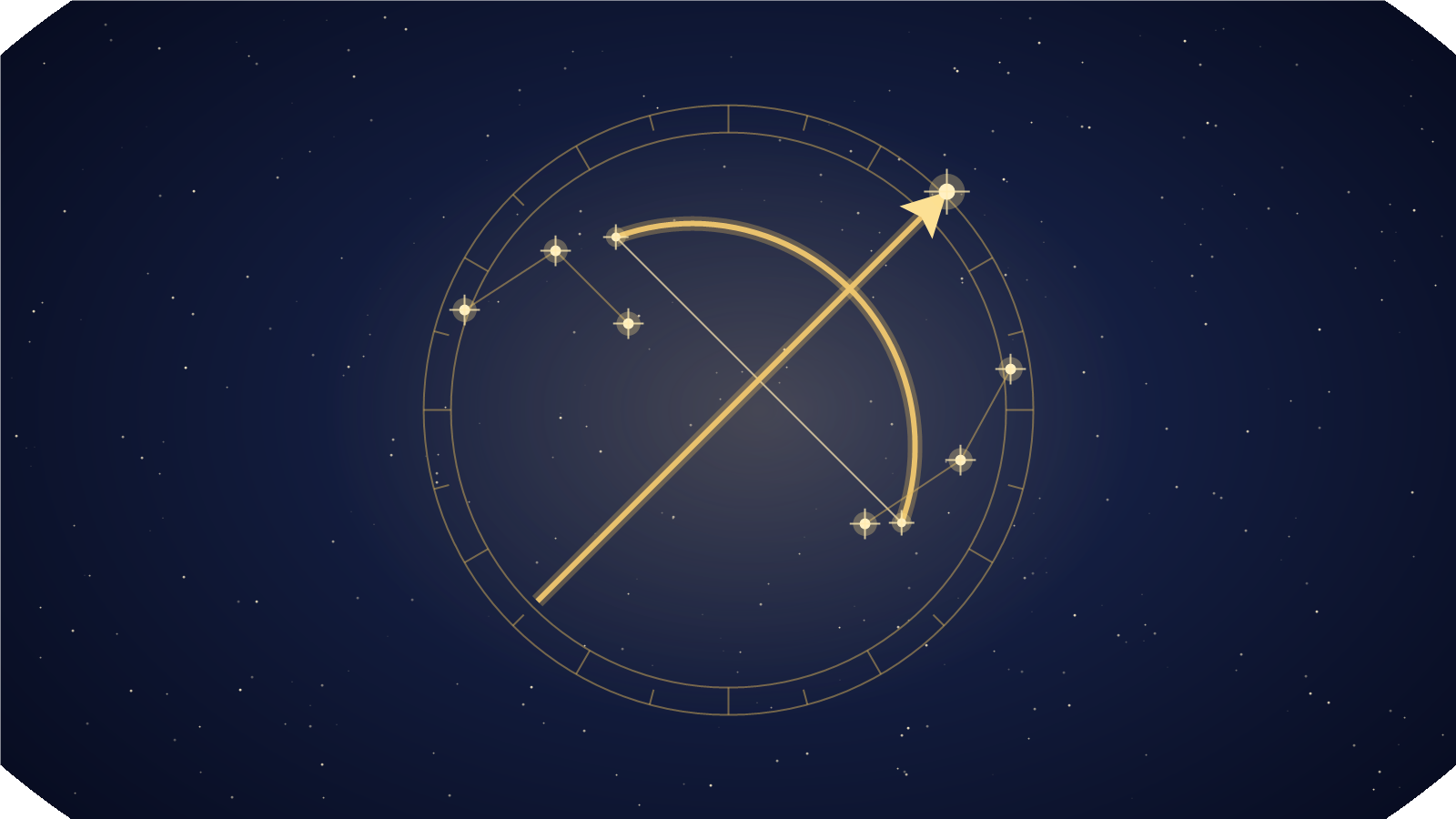
When late November strips the last autumn canopy from northern branches and pushes daylight toward its shortest stretch of the year, the tropical Sun enters Sagittarius. Spanning roughly November 22 through December 21, this ninth sign of the Western zodiac takes the glyph of an arrow angled diagonally upward (♐), pointing past familiar borders toward unexplored terrain. Rather than lingering on settled routines or private emotional currents, Sagittarian symbolism centers on expansion, meaning-making, and the restless urge to test ideas against the wider world.
Understanding Sagittarius accurately requires stepping beyond caricatures of a perpetual backpacker who avoids commitment. In classical and modern astrology alike, this Mutable Fire archetype unites the spark of initiative with the flexibility of an evolving worldview. Whether it appears as your Sun, Moon, or Ascendant—or occupies a prominent house in your natal chart—Sagittarius describes the arena of life where you seek truth through firsthand inquiry, candid dialogue, and philosophical synthesis. Readers exploring how to read a birth chart often discover that even without a Sagittarius Sun, Jupiter’s fiery home shapes at least one pivotal sector of personal growth.
Quick Astrological Reference for Sagittarius
Before examining the deeper psychological and historical layers of the Archer, the summary below consolidates the verified astronomical, traditional, and symbolic correspondences associated with Sagittarius in Western tropical astrology.
| Attribute | Sagittarius Correspondence |
|---|---|
| Tropical Date Range | November 22 – December 21 (ingress shifts slightly by year and time zone) |
| Zodiac Position | Ninth sign (240°–270° celestial longitude) |
| Symbol & Glyph | The Archer / Centaur (♐) |
| Element & Modality | Fire • Mutable |
| Polarity | Diurnal / Active |
| Ruling Planet | Jupiter (Traditional & Modern Domicile) |
| Key Essential Dignities | Jupiter in Domicile; Mercury in Detriment; no classical planetary exaltation or fall |
| Opposite Sign | Gemini |
| Modern House Association | Ninth House (philosophy, higher study, distant travel, ethics, publishing) |
| Vedic (Sidereal) Equivalent | Dhanu (meaning “bow”) |
| Constellation & Brightest Star | Sagittarius; Kaus Australis (Epsilon Sagittarii); direction of the Milky Way Galactic Center |
Ruling Planet, Essential Dignities, and Seasonal Symbolism
Jupiter governs Sagittarius in both Hellenistic tradition and contemporary Western practice, serving as the sign’s diurnal domicile (while Pisces holds Jupiter’s nocturnal home). As the largest planet in our solar system, Jupiter represents magnification, ethical breadth, generosity, and the capacity to spot coherent patterns across disparate facts. Inside Sagittarius, that Jovian principle takes an active, outward-facing expression: rather than absorbing impressions quietly, it asks big questions aloud, builds frameworks of belief, and expects life to reward courage.
Classical essential dignities sharpen this portrait considerably. Because Sagittarius stands directly across the zodiac wheel from Gemini, Mercury—the planet of granular cataloging, tactical messaging, and step-by-step verification—enters its detriment here. A planet in detriment does not imply weakness or malfunction; instead, it operates outside its native toolkit. Mercury in Sagittarius prefers sweeping hypotheses, dramatic storytelling, and big-picture manifestos over proofreading spreadsheets or memorizing isolated minutiae. Notably, Sagittarius contains neither a traditional planetary exaltation nor a planetary fall, which keeps its dignity dynamic sharply focused on the creative tension between Jovian vision and Mercurial detail.
Seasonally, Sagittarius marks the final third of Northern Hemisphere autumn, leading directly to the Winter Solstice. As outdoor temperatures plunge and dusk arrives by late afternoon, communities historically gathered around blazing hearths to swap travel tales, recite epics, and plan journeys for the coming spring. Within the framework of the four elements in astrology, Mutable Fire captures that exact transitional flame: not the sudden flare of an ignition spark or the steady furnace of midsummer, but a portable torch carried across changing territory as one season prepares to turn into the next.
Core Personality Architecture of Sagittarius
At the center of the Sagittarian temperament sits a drive toward cognitive freedom. Where Fixed signs consolidate resources and Cardinal signs initiate formal structures, Mutable Fire thrives on movement across both geographic and intellectual maps. Someone strongly influenced by Sagittarius tends to evaluate experiences by a single unspoken metric: does this widen my horizon, or does it shrink my ceiling? When curiosity stays engaged, their energy feels contagious, humorous, and strikingly resilient in the face of setbacks.
Directness forms another unmistakable pillar of the Archer’s psyche. Sagittarius rarely invests energy in social camouflage or oblique hinting, preferring clear statements even when candor momentarily ruffles feathers. This bluntness usually springs from a philosophical respect for honesty rather than malice; in the Sagittarian mind, withholding an obvious truth wastes everyone’s time. Combined with a sharp ear for irony, that straightforwardness often produces dry wit capable of defusing tense rooms within seconds.
Equally important, yet frequently overlooked in casual horoscope summaries, is the dual nature embedded in the centaur emblem. Half horse and half human archer, the image portrays an enduring dialogue between instinctual appetite and higher aim. A person shaped by this archetype may oscillate between spontaneous physical exuberance—impulse road trips, boisterous debates, hearty celebrations—and solitary stretches of deep reading, comparative religion, or ethical contemplation. Maturity arrives when the instinctive stride and the aimed bow move in the same direction rather than pulling against each other.
Strengths, Shadow Tendencies, and Grounded Growth Habits
Every planetary archetype carries a double edge: the very qualities that make Sagittarius inspiring under balanced conditions can drift into friction when pushed to extremes. Viewing these polarities side by side clarifies how the Archer refines raw enthusiasm into durable wisdom.
| Core Strength | Shadow Expression | Practical Grounding Habit |
|---|---|---|
| Infectious optimism and resilience | Bypassing legitimate grief or logistical risk | Name one concrete constraint before greenlighting a bold plan |
| Refreshing honesty and direct speech | Tactless delivery or unsolicited lecturing | Ask whether a listener wants feedback before offering a critique |
| Synthesizing complex cultural ideas | Dogmatism or intellectual overconfidence | Actively read one credible counterargument on favorite topics |
| Adaptability in unfamiliar settings | Restlessness and abandoning unfinished work | Break long projects into short, adventurous milestones with fixed review dates |
| Generosity of time, humor, and spirit | Overpromising beyond realistic capacity | Wait twenty-four hours before committing to major favors or expenses |
Notice that the shadow side of Jupiter is rarely scarcity; it is excess. Overextending a calendar, speaking before gauging emotional temperature, or mistaking a fresh destination for an internal breakthrough all reflect unchecked Jovian inflation. Growth for Sagittarius does not require shrinking ambition or adopting rigid caution. Instead, it flourishes through intentional pacing—treating follow-through as the bowstring tension that lets an arrow travel farther rather than a cage designed to hold it back.
The Three Decans of Sagittarius
Western astrology divides each 30-degree zodiac sign into three 10-degree segments known as decans. Using the widely practiced triplicity decan system—which assigns sub-rulers from the three signs of the same element—each segment of Sagittarius reveals a noticeably distinct flavor of Fire.
First Decan: 0°–9°59′ Sagittarius (Approx. November 22 – December 1)
Sub-ruled by Jupiter, the opening decan delivers an undiluted double dose of Sagittarian philosophy, candor, and wanderlust. Natives with placements here display an unmistakable appetite for broad cultural fluency, moral inquiry, and humor that punctures pretension. Because Jupiter rules both the sign and the decan, enthusiasm escalates rapidly; these individuals frequently serve as natural educators, mentors, or storytellers who animate any gathering, though they benefit greatly from anchored collaborators who track practical deadlines.
Second Decan: 10°–19°59′ Sagittarius (Approx. December 2 – December 11)
Governed by Mars via the Aries fire triplicity, the middle decan introduces decisive grit, competitive zest, and sharper physical drive. Where first-decan Sagittarius delights in contemplating possibilities, second-decan placements prefer testing theories through direct action and daring first steps. Courage under pressure stands out as a defining signature, accompanied by an impatience with bureaucracy or sluggish consensus. Channeling that Martian spark into athletic pursuits, advocacy, or entrepreneurial sprints prevents frustration from boiling into abrupt confrontations.
Third Decan: 20°–29°59′ Sagittarius (Approx. December 12 – December 21)
Sub-ruled by the Sun through the Leo fire triplicity, the final decan weaves theatrical warmth, creative pride, and magnetic leadership into the Archer’s outlook. Individuals with planets in these late degrees often feel called to share their insights on a visible stage—through publishing, filmmaking, public speaking, or community leadership. Loyalty runs deeper here than in the earlier degrees, paired with a keen desire for recognition when their hard-won perspective enriches others.
Sun, Moon, and Rising Sign Nuances
A zodiac sign expresses itself quite differently depending on which foundational chart point activates it. Reviewing the distinctions outlined in Sun, Moon, and Rising signs explained illuminates why two people with strong Sagittarius placements can come across as remarkably different in daily life.
- Sagittarius Sun: Places core identity and conscious vitality in the realm of exploration, ethical clarity, and lifelong learning. These individuals feel most authentic when pursuing an overarching mission, questioning inherited assumptions, and sharing hard-won insights with people from varied backgrounds.
- Sagittarius Moon: Governs instinctual emotional regulation and what restores inner safety. A Sagittarius Moon settles stress not through quiet domestic brooding, but through perspective—taking a brisk walk outdoors, talking with a candid friend, laughing at absurdity, or planning a future change of scenery. Emotional suffocation or petty guilt-tripping triggers swift withdrawal.
- Sagittarius Rising (Ascendant): Shapes first impressions, physical demeanor, and the overall layout of the natal houses, making Jupiter the chart ruler. People with this Ascendant often project approachable buoyancy, expressive gestures, and an inquiring gaze, while their life path frequently weaves international ties, academia, or philosophical reinvention into major turning points.
Love, Attachment Patterns, and Relationship Needs
In romantic life, Sagittarius equates love with shared expansion rather than possession. Closeness thrives when partners remain curious about each other’s evolving minds and leave oxygen between their individual calendars. Far from being inherently incapable of devotion, a fulfilled Sagittarius shows steadfast loyalty to someone who feels like both an anchor and a co-conspirator—a partner willing to try an unfamiliar cuisine on a Tuesday night, debate a novel over coffee, or navigate an unexpected detour without panicking.
Attachment friction typically surfaces when a relationship turns overly scripted, hyper-monitored, or weighed down by unspoken resentment. Jealous interrogation or rigid domestic expectations make the Archer feel cornered, prompting emotional distancing or sudden restlessness. Conversely, straightforward agreements work wonders: when expectations around time, exclusivity, and shared responsibilities are voiced plainly and revisited honestly, Sagittarius rises to the occasion with warmth and generosity.
Because Sun-sign patterns never tell the whole romantic story, evaluating a partner’s Venus sign in astrology and Mars placement adds vital nuance. A Sagittarius Sun paired with Venus in Scorpio craves intense emotional transparency alongside intellectual freedom, whereas Venus in Capricorn seeks steady, long-range reliability beneath an adventurous exterior. Likewise, refining zodiac sign communication in relationships helps the Archer pair trademark candor with active listening during sensitive conflicts.
Compatibility Across All Four Elements
Astrological chemistry rests on geometric aspects between signs—trines, sextiles, oppositions, squares, and quincunxes—rather than simplistic pass-or-fail labels. Examining how Sagittarius interacts with each elemental group clarifies both effortless resonance and productive friction, a theme explored more broadly in zodiac compatibility in love.
Sagittarius with Fire Signs (Aries, Leo, Sagittarius)
Fellow Fire signs form harmonious trines or conjunctions with Sagittarius, producing immediate rapport, playful banter, and mutual respect for independence. Aries brings fearless momentum that turns Sagittarian theories into live experiments, while Leo contributes steadfast warmth and creative flair. Two Sagittarians share boundless enthusiasm and humor, though both must remember to schedule mundane logistics before passports expire or household errands pile up.
Sagittarius with Air Signs (Gemini, Libra, Aquarius)
Air feeds Fire, making intellectual chemistry with this trio crisp and energizing. Opposite sign Gemini sparks rapid-fire curiosity and lively debate—one zooming in on granular facts while the other sketches the panoramic view, a dynamic frequently highlighted among most compatible zodiac sign pairs. Sextiles to Libra and Aquarius flow smoothly: Libra refines the Archer’s blunt edges with diplomatic poise, while Aquarius matches Sagittarius’s appetite for unconventional ideals and broad social reform.
Sagittarius with Earth Signs (Taurus, Virgo, Capricorn)
Earth signs operate at a steadier tempo, offering tangible grounding alongside occasional stylistic friction. Mutable square partner Virgo challenges Sagittarius’s sweeping generalizations with methodical precision—a pairing that excels once both honor each other’s distinct standards. Adjacent sign Capricorn supplies strategic scaffolding for Jovian visions, while quincunx partner Taurus asks for deliberate compromise between sensory comfort and spontaneous roaming.
Sagittarius with Water Signs (Cancer, Scorpio, Pisces)
Water prioritizes emotional nuance and protective sanctuary, inviting Sagittarius to slow down and attune to subtler currents. Pisces shares Jupiter as its traditional ruler and forms a mutable square with the Archer, bonding easily over spirituality, cinema, and compassion while needing clear agreements around practical boundaries. Scorpio’s psychological depth intrigues Sagittarius when mutual trust holds firm, whereas Cancer teaches the roving Archer that cultivating a true home base can nourish future expeditions rather than curtail them.
Friendship, Family, and Social Circle Dynamics
Outside romantic partnerships, Sagittarius often serves as the social catalyst who introduces disparate friend groups and turns ordinary weekends into lasting stories. Their circle typically spans generations, professions, and cultural backgrounds because they gravitate toward lively minds rather than status markers. Even if months pass without a phone call during busy travel seasons, a Sagittarius friend resumes the conversation with zero pettiness and immediate warmth.
Within family life, Sagittarian relatives resist rigid scripts or unspoken hierarchy. As parents, aunts, uncles, or older siblings, they encourage younger relatives to ask tough questions, explore unfamiliar neighborhoods, and learn from real-world consequences instead of growing up insulated. Holiday tables with an Archer rarely stay monotonous; expect spirited debates, booming laughter, and occasional blunt observations that clear lingering tension. When someone close faces a major move or personal setback, Sagittarius shows up with moving boxes, honest encouragement, and unwavering conviction that a wider chapter awaits.
Career Paths, Leadership Style, and Financial Philosophy
Professionally, Sagittarius wilts under micromanagement, repetitive clerical routines, and opaque office politics. Performance peaks when a role offers autonomy, intellectual variety, and ethical purpose. Ninth House themes map neatly onto modern vocations: higher education, investigative journalism, publishing, international trade, documentary filmmaking, cross-cultural consulting, travel design, constitutional or human-rights law, outdoor guiding, and mission-driven entrepreneurship.
As leaders, Sagittarians excel at articulating a compelling “why” and trusting colleagues to take smart creative risks. Their chief managerial blind spot involves skimming past operational minutiae, which is why pairing a visionary Sagittarian director with an operations-minded deputy often yields standout results. Financially, Jupiter’s influence favors abundance thinking and experiential spending—treating money as fuel for education, flights, books, generous dinners, and bold ventures. Automating baseline savings and reviewing quarterly budgets protects that treasured mobility against overly rosy projections.
Everyday Wellbeing, Stress Signals, and Balance Habits
Because Sagittarius channels vitality through motion and mental stimulation, prolonged stagnation often shows up as irritability before they consciously label themselves stressed. Early warning signs include picking unnecessary arguments, binge-scrolling distant itineraries to dodge routine obligations, overbooking overlapping social plans, or neglecting sleep out of fear of missing out. Sustainable habits work best when framed as stamina for adventure rather than rigid restriction:
- Outdoor rhythmic movement: Trail walking, cycling, archery, dancing, or swimming outdoors satisfies kinetic hunger while naturally settling racing thoughts.
- Structured novelty: Rotating one small weekly ritual—a new podcast genre, an unfamiliar café, or a different recipe—keeps restlessness from derailing long-term goals.
- Mindful pauses before speaking: Taking two quiet breaths during heated moments preserves prized honesty while sharpening its clarity.
- Unplugged reflection windows: Journaling, reading print books, or spending quiet evening hours away from screens lets scattered impressions settle into genuine insight.
Mythology, Tropical Sign vs. Constellation, and Vedic Comparison
The Archer’s celestial lineage stretches back millennia before Hellenistic horoscopes took shape. In ancient Mesopotamia, Babylonian star catalogs identified this region of the sky as PA.BIL.SAG, honoring Pabilsag—a protective warrior-deity of the cities of Isin and Larsa. Carved onto Kassite boundary stones (kudurrus) from the second millennium BCE, Pabilsag appears as a winged centaur drawing a bow, sometimes depicted with a scorpion’s tail and dual heads, uniting martial vigilance with sacred law.
Classical Greek star lore preserved two competing narratives for the constellation. One widespread tradition links Sagittarius to Chiron, the scholarly, gentle centaur who mentored Achilles, Asclepius, and Jason in medicine, music, and ethics—though several ancient mythographers placed Chiron in the southern constellation Centaurus instead. A second authoritative Greek account, recorded by Eratosthenes and Hyginus, identifies Sagittarius as Crotus (Krotos), the inventive son of Pan and Eupheme, nurse of the Muses. Celebrated for pioneering both archery and rhythmic applause, Crotus was set among the stars by Zeus at the Muses’ request—an origin that mirrors Sagittarius’s enduring bond with both physical marksmanship and joyful cultural appreciation.
From an astronomical standpoint, the constellation Sagittarius occupies one of the richest sectors of the night sky: looking toward its familiar “Teapot” asterism directs the eye straight toward the Galactic Center of the Milky Way, home to dense star clouds, the Lagoon and Trifid nebulae, and the supermassive black hole Sagittarius A*. Its brightest star, Kaus Australis (Epsilon Sagittarii, from Arabic and Latin roots meaning “southern bow”), shines at roughly magnitude 1.85.
Crucially, the Western tropical sign Sagittarius does not occupy the same calendar dates as the astronomical constellation Sagittarius. Western astrology anchors its twelve equal 30-degree signs to the seasonal cycle starting at 0° Aries on the Northern Vernal Equinox. Because Earth’s rotational axis slowly wobbles—a phenomenon called axial precession shifting the equinox point roughly 1° every 71.6 years—the tropical zodiac has drifted approximately 23° to 24° relative to the background stars since Hellenistic astronomers standardized the system two thousand years ago. Astronomically, the Sun crosses the official IAU constellation boundaries of Sagittarius around December 18 to January 19, after passing briefly through Ophiuchus in early December. By contrast, Vedic (Jyotish) astrology uses a sidereal zodiac calibrated to fixed stars; its counterpart sign, Dhanu (“bow”), typically runs from roughly December 15 through January 14 and maintains its own distinct planetary rulership and predictive traditions.
Frequently Asked Questions About Sagittarius
Why do Sagittarius start and end dates sometimes shift by a day?
Earth’s orbital year lasts about 365.2422 days rather than an even 365, so the exact moment the Sun crosses 240° celestial longitude varies slightly from year to year and across global time zones. Someone born on November 21, November 22, December 21, or December 22 needs their exact birth time and birthplace to verify whether their Sun sits in late Scorpio, Sagittarius, or early Capricorn.
Does Ophiuchus change a Sagittarius Sun sign in Western astrology?
No. Ophiuchus is an astronomical constellation through which the Sun passes visually along the ecliptic, not a sign of the twelve-part tropical zodiac. Because tropical Western astrology divides the seasonal solar year into twelve exact 30-degree segments anchored to the equinoxes and solstices, adding a thirteenth constellation alters neither tropical sign dates nor traditional chart calculations.
What does it mean that Sagittarius is a Mutable Fire sign?
Within the cycle of cardinal, fixed, and mutable signs, Mutable signs close out each season and excel at adaptation, translation, and course-correction. Paired with the spirited, forward-looking Fire element, Mutability turns Sagittarius into an explorer of meaning—less concerned with defending static territory than with refining vision through movement and fresh experience.
Why is Mercury considered in detriment in Sagittarius?
In traditional planetary dignities, a planet stands in detriment when occupying the sign opposite its domicile. Because Mercury rules Gemini, placing Mercury in opposite sign Sagittarius stretches its detail-oriented faculty across expansive, philosophical terrain. Rather than signaling poor intellect, this placement produces big-picture communicators, engaging lecturers, and swift lateral thinkers who benefit from double-checking fine print.
Are Sagittarians truly afraid of commitment?
Sagittarius rarely fears genuine commitment; it resists stagnation and coercion. When a partnership, career, or community continues to evolve—encouraging honesty, curiosity, and shared goals—Sagittarius can display remarkable devotion over decades. Evaluating Venus, Saturn, and the Seventh House in an individual natal chart provides far clearer insight into relationship longevity than the Sun sign alone.
How does Western Sagittarius differ from Vedic Dhanu Rashi?
Both archetypes honor the bow, Jupiter’s rulership, ethical inquiry, and higher wisdom, yet they rely on different zodiac measurement frames. Western astrology uses the season-linked tropical zodiac (roughly November 22–December 21), whereas Vedic astrology employs the star-aligned sidereal zodiac (roughly December 15–January 14) and places primary emphasis on the Moon sign (Chandra Rashi) and Ascendant (Lagna).
What does it mean if you have no planets in Sagittarius in your birth chart?
Every complete birth chart still contains all twelve signs. Even without natal planets occupying Sagittarius, the house ruled by Sagittarius—along with the natal condition of Jupiter—shows the exact life area where you crave open horizons, spontaneous learning, and ethical perspective.
Closing Reflection
At its finest, Sagittarius reminds us that life expands in proportion to our willingness to keep asking honest questions. Rather than promising a map free of detours, the Archer offers a compass calibrated to candor, humor, and wider perspective—inviting every chart to meet unfamiliar terrain with open eyes.
Editorial Note: Western astrology is presented as a cultural and symbolic framework for reflection rather than a predictive science and should not replace medical, psychological, legal, or financial advice.