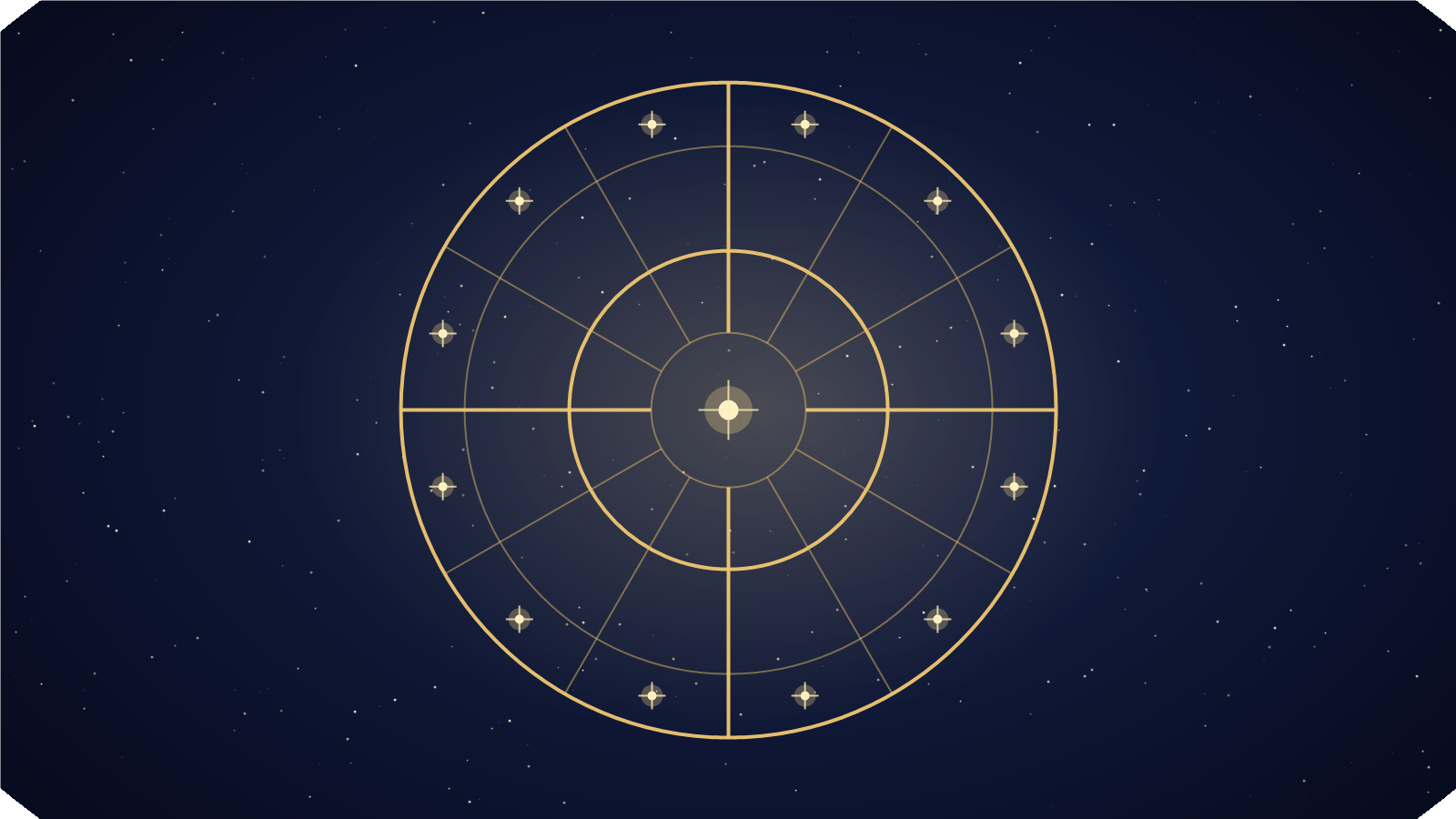
Open any natal chart and you will see a circular wheel sliced into twelve numbered wedges. Those divisions are the astrological houses, transforming a generic planetary snapshot of a calendar date into a map tailored to your exact moment and place of birth. While the twelve zodiac signs measure the Sun’s apparent yearly path around the ecliptic, the houses arise from Earth’s twenty-four-hour axial rotation. Every day, the entire zodiac appears to rise over the eastern horizon, climb overhead, set in the west, and pass beneath our feet. Freezing that daily spin at your first breath locks the twelve houses into position.
Because Earth turns roughly one degree every four minutes, an accurate birth time and birthplace are essential for locating house boundaries. Two people born on the same afternoon in different cities—or two hours apart in the same hospital—share nearly identical planetary signs yet place those planets in entirely different houses. While learning how to read your birth chart, keep three layers distinct: planets represent active drives, zodiac signs color how those drives behave, and houses designate the earthly arenas where life unfolds.
Western astrology uses the Tropical Zodiac anchored to the Vernal Equinox rather than astronomical constellations—shifted roughly twenty-three to twenty-four degrees by axial precession—or the sidereal Rashi system of Vedic Jyotish. Across both traditions, however, the houses remain grounded in local horizon geometry anchored by your Ascendant, explained further in our guide to Sun, Moon, and Rising signs.
Quick Reference Guide to the 12 Astrology Houses
The reference table below summarizes each house’s structural type, core life domains, traditional Planetary Joy from Hellenistic astrology, and opposite axis. Only seven houses hold a classical Planetary Joy—one for each visible body tracked by ancient astronomers—while the remaining five draw potency from angular visibility or relational ties.
| House | Type | Core Life Arenas | Classical Planetary Joy | Opposite Axis |
|---|---|---|---|---|
| 1st House | Angular | Selfhood, vitality, physical carriage, outlook | Mercury | 7th (Self vs. Partner) |
| 2nd House | Succedent | Earned income, movable assets, material stability | None | 8th (Personal vs. Shared Assets) |
| 3rd House | Cadent | Siblings, local errands, writing, early schooling | Moon | 9th (Local vs. Distant Knowledge) |
| 4th House | Angular | Home, ancestry, parents, real estate, roots | None | 10th (Private vs. Public Life) |
| 5th House | Succedent | Creativity, courtship, children, leisure, play | Venus | 11th (Personal Joy vs. Group Vision) |
| 6th House | Cadent | Daily craft, workplace logistics, pets, upkeep | Mars | 12th (Visible Service vs. Quiet Retreat) |
| 7th House | Angular | Marriage, contracts, co-founders, open mirrors | None | 1st (Partner vs. Self) |
| 8th House | Succedent | Joint finances, inheritance, taxes, transitions | None | 2nd (Shared vs. Personal Assets) |
| 9th House | Cadent | Higher study, long travel, ethics, publishing | Sun | 3rd (Distant vs. Local Knowledge) |
| 10th House | Angular | Vocation, public standing, authority, reputation | None | 4th (Public vs. Private Life) |
| 11th House | Succedent | Friendships, alliances, communities, aspirations | Jupiter | 5th (Group Vision vs. Personal Joy) |
| 12th House | Cadent | Solitude, rest, behind-the-scenes work, unseen patterns | Saturn | 6th (Quiet Retreat vs. Visible Service) |
Angular, Succedent, and Cadent Houses—Plus Chart Hemispheres
Classical Greek and Persian astrologers grouped the twelve houses into three tiers based on their geometric proximity to the four horizon and meridian pivots. These classifications explain why one planetary placement produces highly visible public events while another operates steadily out of sight.
Angular Houses: The Four Structural Pillars (1st, 4th, 7th, and 10th)
Angular houses align with the four compass points of your local sky: the eastern rising horizon (Ascendant, 1st), the nocturnal depth beneath Earth (Imum Coeli, 4th), the western setting horizon (Descendant, 7th), and overhead culmination (Midheaven, 10th). Planets stationed here act with immediate visibility and decisive momentum. Comparable in initiating force to the modalities explored in cardinal, fixed, and mutable signs, angular placements steer identity, domestic roots, committed bonds, and public calling.
Succedent Houses: Sustaining Resources and Output (2nd, 5th, 8th, and 11th)
From the Latin word meaning “to follow,” succedent houses rise behind the angles to supply the material, creative, and social fuel that keeps angular endeavors standing. Earnings in the 2nd nourish the self of the 1st; joyful creations in the 5th blossom from the domestic foundation of the 4th; pooled resources in the 8th back the commitments of the 7th; and loyal networks in the 11th amplify the achievements of the 10th.
Cadent Houses: Learning, Maintenance, and Transition (3rd, 6th, 9th, and 12th)
Derived from the Latin verb meaning “to fall away,” cadent sectors move past the angular peaks. Older manuals treated cadent planets as quieter in public status, yet equating cadent with unimportant misses a decisive historical clue: four of the seven Planetary Joys—Moon in the 3rd, Mars in the 6th, Sun in the 9th, and Saturn in the 12th—reside in cadent houses. Rather than chasing spotlights, cadent placements excel at study, mental agility, daily upkeep, philosophy, and quiet preparation for upcoming chapters.
Upper, Lower, Eastern, and Western Chart Hemispheres
Observing which halves of the wheel hold the most planets highlights overarching life orientation:
- Southern or Upper Hemisphere (Houses 7–12): Representing the daylight sky above the horizon, strong concentration here tilts energy toward outward visibility, public contribution, and social engagement.
- Northern or Lower Hemisphere (Houses 1–6): Sitting below the horizon, dense placements here prioritize interior grounding, private skill-building, and domestic rootedness before public display.
- Eastern Hemisphere (Houses 10–12 and 1–3): Flanking the Ascendant on the rising side, this cluster encourages self-directed initiative, autonomy, and setting one’s own pace.
- Western Hemisphere (Houses 4–9): Gathering near the Descendant on the setting side, this distribution highlights collaboration, interpersonal responsiveness, and growth shaped through external feedback.
The horizontal horizon axis separating houses 1 through 6 from houses 7 through 12 also determines one of classical astrology’s oldest distinctions: chart sect. If the Sun sits above the horizon in the upper hemisphere, you have a diurnal (day) chart, where Jupiter and Saturn traditionally operate with cleaner clarity; if the Sun sits below the horizon in the lower hemisphere, you have a nocturnal (night) chart, where the Moon, Venus, and Mars traditionally express their most constructive support.
Detailed Breakdown of All 12 Astrology Houses
Every house forms a polarity with the sector directly across the wheel. Examining each domain individually illustrates how classical astrological concepts appear in everyday modern life.
1st House: The Helm of Identity and Physical Presence
Hellenistic astrologers named the 1st house Horoskopos (“hour-marker”) and called it the Helm, like a ship’s rudder steering across open water. Anchored by the Ascendant, it represents vitality, instinctive posture, temperament, and the spontaneous lens through which you enter unfamiliar rooms. Mercury rejoices here because mind and body function together as one perceptive instrument. Saturn in the 1st often conveys calm poise that softens noticeably with age, whereas Jupiter in the 1st frequently brings buoyant warmth and unmistakable presence before a word is spoken.
2nd House: Personal Finances, Skills, and Material Security
Moving beneath the horizon, the 2nd house covers everything you earn, own, and cultivate to sustain daily life: bank balances, portable goods, marketable abilities, and tactile security. Ancient texts nicknamed it the Gate of Hades because it sits beside the Ascendant without forming a classical geometric aspect to it, hinting at the steady, unglamorous work behind financial resilience. Mars here may earn in focused sprints and spend decisively, while Venus often gravitates toward steady income streams tied to design, hospitality, or craftsmanship.
3rd House: Everyday Communication, Siblings, and Local Rhythms
Traditionally called the House of the Goddess and the Planetary Joy of the Moon, the 3rd house depicts your immediate mental neighborhood: siblings, cousins, local streets, daily commutes, short trips, primary schooling, and practical writing or speech. Because the Moon cycles swiftly through shifting phases, its joy here mirrors ordinary repetition—answering messages, running errands, and keeping neighborhood bonds alive. Planetary placements here complement the relational habits discussed in zodiac sign communication in relationships.
4th House: Home, Family Lineage, and Emotional Bedrock
At the chart’s lowest point rests the Imum Coeli, governing ancestry, parents, early household atmosphere, land, real estate, and the sanctuary you maintain behind closed doors. Where the opposite 10th house displays your public biography, the 4th reveals who you are in private and what domestic environment restores your peace. Prominent 4th-house placements often feel deeply connected to family history, regional architecture, or culinary heritage, sometimes channeling their care into interior restoration, hospitality, or creating a lasting family homestead.
5th House: Creative Expression, Romance, Joy, and Children
Celebrated historically as Good Fortune and the Planetary Joy of Venus, the 5th house encompasses pursuits undertaken purely for delight, artistry, and heartfelt vitality. Dating and courtship, theater, music, athletic recreation, creative risk-taking, and children—both offspring and passion projects—belong here. Reading your 5th-house planets alongside your natal Venus sign in astrology clarifies what sparks genuine pleasure and prevents hobbies from turning into another productivity obligation.
6th House: Daily Craft, Service, Routines, and Physical Maintenance
Historically termed Bad Fortune because it represents toil and friction rather than ease, the 6th house is the Planetary Joy of Mars—the planet of grit, troubleshooting, and stamina. Today it signifies daily workflow, coworkers, small domestic animals, scheduling systems, and personal upkeep routines. Astrologers treat 6th-house indicators purely as symbolic prompts for work-life balance rather than medical predictions. An active 6th house frequently belongs to skilled editors, artisans, clinicians, or operations managers who thrive on solving tangible logistical challenges.
7th House: Committed Partnerships, Alliances, and Legal Contracts
Directly across from the Ascendant at the western horizon sits the Descendant, opening the 7th house of formalized one-on-one alliances. Unlike the lighthearted romance of the 5th, the 7th governs binding commitments where two equals share responsibility: marriage, life partners, business co-founders, agents, legal contracts, and open opponents who meet you face-to-face. Studying this sector adds essential depth to zodiac compatibility in love and illuminates why dynamics among most compatible zodiac sign pairs extend far beyond Sun signs.
8th House: Shared Resources, Inheritance, and Major Thresholds
Opposite your personal assets in the 2nd house, the 8th covers resources woven together with other people or institutions: a partner’s income, venture funding, mortgages, grants, taxes, insurance, and inheritances. Emotionally, it symbolizes deep trust, financial interdependence, grief, and profound life chapters where old attachments dissolve to make room for renewal. Ancient authors named it the Idle Place because it makes no major classical aspect to the rising sign, reflecting how its events often depend on external agreements and shared timing.
9th House: Higher Education, Long Journeys, Ethics, and Publishing
Known traditionally as the House of God and the Planetary Joy of the Sun, the 9th expands the local inquiry of the 3rd into wide-horizon meaning. Universities, advanced research, foreign languages, long-distance travel, law, ethics, comparative religion, mentorship, and publishing reside here. The Sun rejoices in this sector because clarity requires enough elevation to view the landscape whole. Strong 9th-house placements rarely settle for fragments; whether crossing borders or studying ancient texts, they seek coherent philosophies linking knowledge into lived wisdom.
10th House: Career, Public Reputation, and Worldly Legacy
Near the zenith of the chart sits the 10th house—closely tied to the Midheaven—representing your visible standing in society, vocational arc, leadership style, public honors, and lasting contribution. While the 6th describes daily tasks and the 2nd tracks earnings, the 10th reveals what people respect you for and how you engage authority. A Sun or Jupiter near the Midheaven often draws individuals into recognized public roles—entrepreneurship, teaching, authorship, or civic leadership—even when their private nature prefers quiet spaces.
11th House: Communities, Friendships, Patrons, and Future Hopes
Termed Good Spirit and the Planetary Joy of Jupiter, the 11th house signifies supportive networks, civic groups, trade guilds, close friends, influential allies, and long-term aspirations. Positioned beside the 10th, it historically represented the goodwill and tangible backing generated by public work. Where the 5th house explores individual delight, the 11th asks what collective future you want to build alongside peers who share your principles—from neighborhood cooperatives and professional associations to mission-driven communities.
12th House: Solitude, Behind-the-Scenes Craft, and Inner Unwinding
Completing the wheel just above the eastern horizon is the 12th house, historically called Bad Spirit and designated as the Planetary Joy of Saturn. Classical texts linked it to exile, hidden struggles, and enclosed institutions such as monasteries or sanctuaries. Modern readings broaden this symbolism to include deliberate retreat, meditation, restorative sleep, unconscious blind spots, quiet service, and unseen creative work—such as ghostwriting, film editing, archival study, or therapeutic listening. Saturn thrives here because stillness and patience convert solitude into lasting inner clarity.
Debunking the 12-Letter Alphabet: Why Aries Does Not Rule the 1st House
Beginner astrology articles frequently claim that Aries is the “natural ruler” of the 1st house, Taurus rules the 2nd, Gemini rules the 3rd, and so forth around the circle. That pedagogical shorthand—introduced in the twentieth century by psychologist-astrologer Zipporah Dobyns as the “Twelve-Letter Alphabet”—was created purely as a memorization tool. Treating it as literal chart doctrine, however, merges two independent layers and distorts real interpretation.
Classical Hellenistic, Persian, Indian, and Renaissance astrologers never assigned zodiac signs as generic house rulers. Signs describe how energy moves; houses specify where it manifests. Consider someone born with Cancer rising on the eastern horizon: their 1st house expresses intuitive, protective lunar poise rather than Martian bluntness, while Aries occupies their 10th house—channeling bold initiative into public vocation instead of first impressions.
Equating the 7th house with Libra or the 8th with Scorpio only happens to align when Aries is rising. For the other eleven Ascendants, every single house is governed by a completely different sign and planetary lord. Setting aside the Twelve-Letter Alphabet immediately sharpens chart analysis because you read the actual sign occupying each cusp rather than superimposing a generic template.
House Rulers and Empty Houses: Reading Unoccupied Sectors
Newcomers often worry when they spot empty houses in their natal wheel, yet basic math resolves that concern at once. Every chart contains twelve houses but only seven classical planets (or ten including Uranus, Neptune, and Pluto). Even when planets spread widely across the sky, every single person has at least two—and commonly four to six—unoccupied houses.
An empty house never implies an absent or barren area of life. An unoccupied 7th house does not foretell lifelong solitude, nor does an empty 10th block meaningful achievement. Instead, empty sectors usually run with less internal friction, and astrologers interpret them through the house ruler (house lord)—the planet governing the zodiac sign on that house’s cusp.
Take a practical example: suppose your 7th house of partnership contains zero planets and opens in Taurus. Because Venus rules Taurus, Venus serves as your 7th-house lord. If natal Venus sits in your 10th house in Leo, committed partnerships weave naturally into career visibility, creative ventures, or meeting significant partners through professional settings. Likewise, an empty 2nd house in Virgo whose ruler Mercury sits in the 9th house links personal earnings with teaching, editing, publishing, or international consulting. For cusps in Scorpio, Aquarius, or Pisces, many readers examine both the traditional lord (Mars, Saturn, or Jupiter) and the modern outer ruler (Pluto, Uranus, or Neptune).
Tracing house lords also uncovers cooperative feedback loops called mutual receptions, which occur when two house rulers sit inside each other’s home signs. For example, if the ruler of your 10th house of vocation stands in your 3rd house of writing while the ruler of your 3rd house occupies your 10th, public reputation and everyday communication continuously reinforce one another—even when one of those sectors holds few or no natal planets.
House Systems Compared: Whole Sign, Placidus, and Equal House
If your planets appear in slightly different houses on two astrology apps, nothing moved in the sky—each site simply applied a different mathematical house system. Projecting a tilted, three-dimensional celestial sphere onto local horizon geometry involves geometric choices, particularly near high northern or southern latitudes. Three systems lead Western practice today.
| Feature | Whole Sign Houses | Placidus Houses | Equal House System |
|---|---|---|---|
| Historical Origin | Hellenistic antiquity (~2nd–1st century BCE); parallels Vedic Bhava roots | 17th century (popularized by Placido de Titis) | Classical antiquity; revived in 20th-century British astrology |
| Calculation Basis | Entire rising zodiac sign (0°–30°) forms the 1st house, next sign is 2nd, etc. | Time-based quadrant division of planetary semi-arcs above and below horizon | Uniform 30° segments measured directly from the exact Ascendant degree |
| Cusps & Interceptions | Uniform 30° houses; zero intercepted signs | Unequal widths; can produce wide houses and intercepted signs at high latitudes | Uniform 30° houses; zero intercepted signs |
| Midheaven Placement | Floats freely into the 9th, 10th, or 11th house as a career sensitivity point | Locked permanently onto the exact starting cusp of the 10th house | Floats independently near the 9th, 10th, or 11th house |
| Best Use Case | Crisp house rulerships, clean timing techniques, traditional clarity | Layered psychological nuance and sharp angular cusp sensitivity | Uniform geometry preserving the exact Ascendant degree as the 1st-house boundary |
Whole Sign Houses are the oldest documented framework in Western astrology and have surged back into mainstream popularity. Because each house spans one complete sign, house lords remain unambiguous and high-latitude distortions disappear. Allowing the Midheaven to float into the 9th, 10th, or 11th house also adds fresh nuance—for instance, a 9th-house Midheaven connects public vocation with higher learning or global travel.
Placidus Houses remain the software default for many modern chart calculators. Dividing planetary travel times between horizon and meridian locks the Ascendant to the 1st cusp and Midheaven to the 10th, highlighting unequal house sizes and intercepted signs, though its equations break down near polar latitudes.
Equal House offers clean symmetry by starting every subsequent house at the exact degree of the Ascendant. Testing Whole Sign alongside Placidus against real turning points in your biography is the most grounded way to see which boundaries resonate most clearly.
Frequently Asked Questions About the 12 Astrology Houses
Can I determine my astrology houses without knowing my exact birth time?
Accurate houses require a reliable birth time because the Ascendant changes zodiac signs roughly every two hours and advances one degree every four minutes. Without a birth certificate timestamp, you can still interpret planetary signs, aspects, and balances across the four elements in astrology; some readers also explore a provisional sunrise chart placing the Sun on the 1st house purely as a symbolic fallback.
What does a stellium in one house signify?
A stellium forms when three or more planets gather inside a single house. That concentration focuses unusual energy, talent, and repeated lessons onto one arena—such as domestic life in the 4th or community vision in the 11th—making it valuable to cultivate conscious balance with the opposite house on the wheel.
Why did my planets shift houses when I switched house systems?
Toggling between Placidus and Whole Sign never changes where planets physically stood at your birth; it simply repositions the mathematical boundary lines. Planets sitting within a few degrees of a quadrant cusp are the ones most likely to step into an adjacent sector.
Are the 6th, 8th, and 12th houses genuinely unlucky?
Hellenistic astrologers categorized the 6th, 8th, and 12th houses—along with the 2nd—as challenging because their signs stand in “aversion” to the 1st house, forming no classical major aspect to the rising sign. Practically, these arenas simply call for steadier patience, humility, or behind-the-scenes work rather than effortless spotlight: daily craftsmanship, shared vulnerability, and restorative solitude.
How do planetary transits activate my natal houses?
As planets orbit the Sun today, they move sequentially through your twelve natal houses, highlighting each domain in turn. The swift Moon crosses a house in roughly two and a half days, whereas Saturn spends about two and a half years per sector—frequently coinciding with major chapters of structural maturity.
Are Vedic astrology houses (Bhavas) identical to Western houses?
Vedic Jyotish divides the sky into twelve Bhavas whose core domains—self, wealth, siblings, home, children, service, partnership, longevity, dharma, career, gains, and liberation—closely echo Hellenistic house traditions. The primary difference stems from the zodiacal baseline: because Vedic astrology uses the sidereal zodiac adjusted by roughly twenty-three to twenty-four degrees of precession, most people have a different rising sign (Lagna) and house-sign alignment than in Western tropical charts.
Which house reveals my career: the 2nd, 6th, or 10th?
Astrologers examine all three together as the vocational triad. The 10th house describes public reputation and overarching calling; the 6th reveals daily tasks, workplace environment, and practical craft; and the 2nd shows how you turn effort into personal income and material stability.
Note on Astrology: Western astrology is a traditional cultural and symbolic framework intended for reflection and self-study rather than deterministic forecasting. Birth chart readings should never substitute for qualified medical, psychological, legal, or financial counsel.