
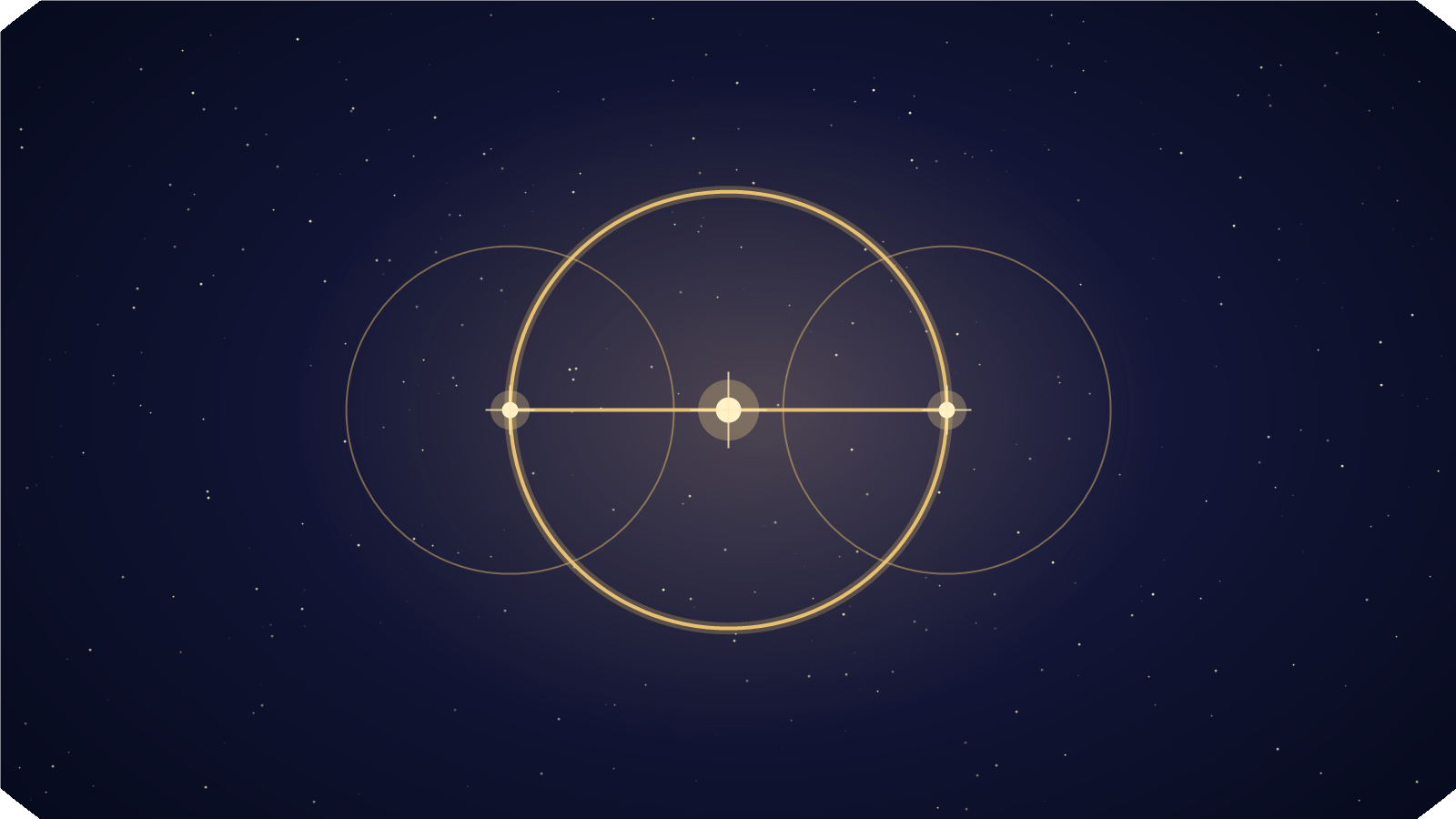
When two people spend meaningful time together, something subtle takes shape between them that belongs strictly to neither individual alone. You might be brisk and independent in everyday life yet noticeably gentler around a specific partner, or calm by nature yet unusually adventurous alongside a longtime friend. In modern Western astrology, the composite chart was designed to map that shared atmosphere directly. Rather than laying two birth charts side by side to see how one person triggers the other, a composite chart blends two horoscopes into a single, independent third chart representing the relationship itself as its own symbolic entity.
Technically, a composite chart calculates the mathematical midpoint along the shortest arc of the 360-degree ecliptic between Partner A’s Sun and Partner B’s Sun, Moon and Moon, Venus and Venus, and every remaining planet and angle. While midpoint geometry first gained traction in early twentieth-century German Uranian astrology (pioneered by Alfred Witte) and Reinhold Ebertin’s cosmobiology, the modern composite relationship chart entered mainstream English-language astrology during the 1970s. American astrologer John Townley introduced the technique widely in The Composite Chart (1974), and Robert Hand cemented its place as an indispensable relationship tool with his landmark 1975 manual Planets in Composite: Analyzing Human Relationships.
Like most mainstream approaches to zodiac compatibility in love, Western composite astrology operates within the Tropical Zodiac—twelve equal 30-degree seasonal signs measured from 0° Aries at the Vernal Equinox, distinct from astronomical star constellations shifted roughly 23 to 24 degrees by axial precession and distinct from Vedic Sidereal charts. If you already know the fundamentals of how to read your birth chart, learning to read a composite chart unlocks a remarkably clear vantage point: it shows not merely whether two people attract one another, but what kind of living container their bond builds over time.
Composite Chart vs. Synastry Chart vs. Davison Chart
Relationship astrologers rely on three distinct chart techniques, each answering a different question about a partnership. Beginners often confuse the composite chart with synastry or with the Davison Relationship Chart, pioneered by British astrologer Ronald C. Davison in the 1970s. Comparing all three side by side clarifies exactly what a composite chart can—and cannot—show you.
| Feature | Synastry Chart | Composite Chart | Davison Relationship Chart |
|---|---|---|---|
| Calculation Method | Bi-wheel overlay comparing Person A’s natal planets directly against Person B’s natal chart | Mathematical midpoints along the shortest ecliptic arc between each matching pair of planets and angles | A single real natal chart cast for the exact midpoint in calendar time and geographic latitude/longitude |
| Core Question Answered | How do we affect, attract, soothe, or irritate each other personally? | What is this relationship as a standalone third entity, and what is its shared purpose? | What real-world trajectory, timing, and external life events unfold around this bond? |
| Astronomical Reality | Two genuine historical skies from two separate births | Pure geometric synthesis; can display planetary angles impossible in an actual sky | One real historical sky that genuinely occurred at a specific date, time, and place on Earth |
| Birth Time Requirement | Needed for house overlays and angle contacts; planet-to-planet aspects work without it | Essential for Composite Rising, Midheaven, and houses; planetary midpoints still work without it | Required to compute accurate midpoint clock time, Rising sign, and house cusps |
| Strongest Use Case | Understanding romantic spark, emotional triggers, and individual needs inside the pair | Reading couple identity, shared culture, public image, and long-term themes | Tracking transits, progressions, and developmental milestones across years together |
In practice, synastry and composite charts complement rather than compete with one another. Synastry explains why two individuals from supposedly mismatched pairings still outshine textbook most compatible zodiac sign pairs through intimate planet-to-planet hooks. Once synastry reveals how Partner A and Partner B feel around each other, the composite chart zooms out to show what the partnership looks like from the outside—and what shared mission keeps the bond coherent once the initial rush settles.
How Midpoint Calculation Works (and Why “Impossible” Aspects Appear)
Calculating a composite placement is simpler than it sounds once you picture the zodiac as a 360-degree circle starting at 0° of the Aries zodiac sign and advancing 30 degrees per sign through Pisces. Suppose Partner A has a natal Sun at 10° Aries (10° absolute ecliptic longitude) and Partner B has a natal Sun at 20° Gemini (80° absolute longitude). The shortest arc connecting 10° and 80° measures 70 degrees. Dividing that span in half gives 35 degrees; adding 35 degrees to 10° Aries places the Composite Sun squarely at 45° absolute longitude, which translates to 15° Taurus.
Astrology software always selects the shortest arc—the span measuring less than 180 degrees—rather than the long way around the wheel. The only mathematical edge case occurs when two matching planets stand exactly 180 degrees apart in direct opposition, where both halves of the circle are equidistant. When a Composite Sun lands on an exact opposition, astrologers look to where the pair’s Composite Mercury or Venus clusters to determine which of the two opposing degrees carries the solar center of gravity. For house cusps, most modern platforms use Robert Hand’s Midpoint Midheaven method—averaging both natal Midheavens and deriving the Composite Ascendant and houses from a chosen reference latitude—though some programs also offer a Reference Place calculation anchored to where the couple currently lives.
Because each composite planet is computed independently as a geometric average rather than photographed from an actual sky, composite charts exhibit a fascinating astronomical quirk: they can contain planetary aspects that are physically impossible in any real natal or Davison chart. In observational astronomy, Mercury orbits close to the Sun and can never appear farther than roughly 28 degrees away from it from Earth’s vantage point, while Venus can never exceed roughly 48 degrees of elongation. Consequently, no human being is ever born with natal Sun opposite Mercury or natal Sun square Venus.
In a composite chart, however, those exact “impossible” aspects happen regularly. Imagine Partner A born with Sun at 5° Aries and Mercury at 25° Pisces, paired with Partner B born with Sun at 5° of the Libra zodiac sign and Mercury at 20° Libra. Because their Suns sit nearly opposite while their Mercuries tip slightly past the dividing line, the shortest arc for the Sun can flip to the Cancer/Capricorn side while the shortest arc for Mercury lands on the opposite hemisphere—producing a Composite Sun opposite Mercury (180°) or, with a similar shift, a Composite Sun square Venus (90°). Far from being a software error, astrologers treat these exotic aspects as vivid symbols: Composite Sun opposite Mercury often describes a couple whose shared vision and everyday communication style operate at crossed angles until both people practice conscious translation, while Composite Sun square Venus highlights tension between shared life responsibilities and carving out unhurried romance.
Reading the Core Placements in a Composite Chart
Interpreting a composite chart mirrors reading an individual horoscope, with one vital mental shift: every planet describes a trait of the relationship rather than a single person’s personality. Just as understanding your Sun, Moon, and Rising signs anchors natal interpretation, starting with the composite chart’s core luminaries, angles, and personal planets yields the clearest snapshot of how a partnership breathes.
Composite Sun: The Shared Purpose and Heartbeat
The Composite Sun defines why the relationship feels alive and what core identity the pair radiates together. Examining its sign through the lens of the four elements in astrology and Cardinal, Fixed, and Mutable signs immediately sets the tone: a Composite Sun in Cardinal Fire pursues bold joint adventures and new beginnings, whereas a Fixed Earth Composite Sun thrives on steady rituals, tangible security, and building something durable side by side. When a couple neglects the themes of their Composite Sun, the bond can begin to feel curiously flat even if both people still care deeply.
Composite Moon: The Private Emotional Climate
If the Composite Sun shows how a couple shines in daylight, the Composite Moon reveals how the relationship feels behind closed doors on a tired Tuesday evening. It governs emotional security, instinctive habits, domestic atmosphere, and how the pair responds when unexpected stress hits. A Composite Moon in Water craves quiet sanctuary and unspoken attunement; a Composite Moon in Air metabolizes feelings by talking every nuance through over late-night tea. Because the Moon moves swiftly, accurate birth times are especially valuable when checking whether the Composite Moon shifts degrees or crosses a sign boundary.
Composite Ascendant (Rising): The Couple’s Public Persona
The Composite Ascendant captures the immediate impression two people project when they walk into a dinner party, host friends, or collaborate professionally. A couple with a Leo Composite Rising often looks radiant, playful, and warm to outsiders, whereas a Virgo Composite Rising appears composed, thoughtful, and quietly helpful—even if their private Composite Moon is wildly romantic. Equally important is the composite chart ruler (the traditional planetary ruler of the Rising sign), whose house placement points directly to the area of life steering the relationship’s outward story.
Composite Mercury: Shared Language and Decision-Making
Composite Mercury describes the mental channel between two people—their shared humor, inside jokes, curiosity, and problem-solving cadence. Closely tied to zodiac sign communication in relationships, this placement shows whether the pair negotiates conflicts swiftly through direct debate or prefers letting thoughts simmer before speaking. Strong harmony between Composite Mercury and the Composite Moon or Jupiter tends to produce effortless conversation that keeps a long-term partnership mentally fresh decades after the first meeting.
Composite Venus: Affection, Values, and Pleasure
Whereas an individual’s Venus sign in astrology shows personal romantic taste, Composite Venus reveals the mutual affection, aesthetic pleasures, and shared values that make a couple genuinely enjoy each other’s company. It answers practical questions: What kinds of dates recharge you both? How do you express tenderness, spend discretionary money, and keep appreciation visible? A well-supported Composite Venus acts as a natural buffer during tough chapters, reminding both partners why they chose one another in the first place.
Composite Mars: Shared Drive, Conflict, and Momentum
Composite Mars embodies the partnership’s active engine—how the pair initiates joint goals, handles disagreement, and maintains physical or creative vitality. In constructive form, Composite Mars fuels teamwork, athletic hobbies, entrepreneurial courage, and lively passion. When left unchanneled, however, Mars can flare into impatience, bickering over minor logistics, or simmering resentment. Knowing the sign and house of Composite Mars gives a couple a healthy outlet for competitive or restless energy before it turns inward.
Composite Saturn: Commitment, Boundaries, and Longevity
Composite Saturn indicates where the relationship encounters real-world gravity—agreements, responsibilities, patience, and structural integrity. Much like the disciplined tone of the Capricorn zodiac sign, Saturn in a composite chart rarely hands out effortless shortcuts, yet it frequently appears prominently in enduring marriages, co-parenting alliances, and multi-year creative ventures. Rather than signaling automatic hardship, Saturn’s house shows the exact arena where steady follow-through transforms casual fondness into unshakeable trust.
Composite Sun Through All 12 Houses: Where Shared Energy Flows
Experienced astrologers often pay even closer attention to the house placement of the Composite Sun than to its zodiac sign. The sign colors how the partnership expresses itself, while the house reveals where in everyday life the couple naturally invests their time, identity, and shared purpose.
| Composite Sun House | Primary Relationship Arena | Everyday Expression | Growth Edge |
|---|---|---|---|
| 1st House | Shared Identity and Visibility | Friends view the pair as a distinct, unmistakable unit; strong mutual presence | Preserving healthy personal autonomy alongside couple identity |
| 2nd House | Resources, Comfort, and Security | Building financial stability, savoring good food, creating tangible steadiness | Avoiding possessiveness or reducing intimacy to material checklists |
| 3rd House | Conversation and Daily Curiosity | Endless banter, local day trips, shared reading lists, lively sibling-like ease | Remembering to drop beneath clever chatter into deeper vulnerability |
| 4th House | Home, Roots, and Private Sanctuary | Nesting together, hosting intimate family meals, prioritizing emotional safety | Preventing excessive insularity or repeating inherited family habits |
| 5th House | Joy, Creativity, and Romance | Playful dates, artistic collaboration, celebratory warmth, youthful spark | Navigating mundane chores once the festive mood quiets down |
| 6th House | Daily Rhythms and Mutual Service | Coordinating routines, supporting wellness habits, thriving as everyday teammates | Keeping romance alive so partnership does not feel purely logistical |
| 7th House | Conscious Partnership and Mirroring | Classic one-on-one devotion, diplomatic negotiation, strong relational focus | Balancing compromise with candid honesty about individual desires |
| 8th House | Deep Trust and Transformation | Intense candor, shared finances or crises, profound psychological evolution | Releasing control battles and honoring privacy without secrecy |
| 9th House | Travel, Learning, and Worldview | Exploring new cultures, debating philosophy, cheering higher education and growth | Staying grounded in day-to-day commitments between big horizons |
| 10th House | Public Ambition and Legacy | Power-couple visibility, career backing, joint community leadership or business | Leaving work roles at the door to nurture private tenderness |
| 11th House | Friendship, Community, and Ideals | Meeting through shared causes, hosting wide circles, valuing egalitarian freedom | Cultivating intimate emotional closeness amid active social calendars |
| 12th House | Solitude, Intuition, and Quiet Healing | Private spiritual or creative retreat, deep empathy, fiercely guarded inner life | Speaking unspoken expectations clearly before confusion accumulates |
Key Composite Aspects to Notice (Without Panicking Over Heavy Placements)
When scanning planetary aspects inside a composite chart, tighter orbs matter far more than wide ones. Because a composite chart is already a mathematical distillation of two charts, astrologers generally prioritize conjunctions (0°), squares (90°), trines (120°), sextiles (60°), and oppositions (180°) within roughly 5 to 6 degrees for the Sun and Moon, 3 to 5 degrees for personal planets, and 2 to 3 degrees for outer planets. Supportive links—such as Composite Sun conjunct Venus, Moon trine Jupiter, or Venus sextile Mars—provide genuine resilience, warmth, and ease when external life gets chaotic.
At the same time, newcomers frequently misread three specific composite themes as warning signs of inevitable heartbreak when traditional practice views them far more nuancedly:
- Composite Saturn Squares and Oppositions: Seeing Saturn square the Composite Sun or Moon often alarms readers online, yet Robert Hand noted decades ago that strong Saturn contacts appear reliably in long-lasting bonds. Hard Saturn aspects do not doom a couple; they simply signal that the partnership asks for mature boundaries, realistic pacing, and conscious effort rather than gliding on automatic pilot.
- Composite Pluto Aspects: Echoing the regenerative depth of the Scorpio zodiac sign, Composite Pluto touching Venus, Moon, or the Ascendant points to a relationship that resists superficiality. Both people change noticeably through knowing one another. The practical caution is watching for silent power struggles or emotional scorekeeping; handled with honesty, Pluto aspects build extraordinary loyalty and courage.
- Composite 12th House Placements: Internet myths routinely equate a 12th House Composite Sun or Venus with hidden affairs or doomed secrecy. In everyday practice—much like the contemplative sensitivity of the Pisces zodiac sign—12th House composite placements often describe couples who protect their relationship fiercely from social-media scrutiny, bond over music, therapy, or spiritual practice, or heal old relational fatigue together in quiet privacy.
Remember also that outer planets (Uranus, Neptune, and Pluto) move so slowly that two people born within a few years of each other will almost always share composite outer-planet placements close to their natal generational degrees. Unless an outer planet forms a tight aspect to the Composite Sun, Moon, Venus, Mars, or an angle (Ascendant or Midheaven), it operates quietly in the background rather than dominating daily life.
Step-by-Step Guide to Generating and Interpreting Your Composite Chart
You do not need advanced mathematics to draw an accurate composite chart—reputable astrology platforms calculate every midpoint automatically in seconds. Following a structured six-step sequence keeps interpretation grounded and prevents overwhelm.
- Step 1 — Verify Birth Data for Both People: Gather exact birth dates, birth cities, and birth times from official records whenever possible. If one partner’s birth time is unknown, you can still generate planetary signs and planet-to-planet aspects (keeping in mind that the Composite Moon could shift by up to six or seven degrees), while setting aside house cusps and the Composite Rising sign.
- Step 2 — Choose the Midpoint Composite Option: Inside your preferred chart calculator, select “Composite Chart (Midpoint Method)” rather than synastry or Davison. Check whether your software defaults to Midpoint Houses or Reference Place Houses, and pick a consistent house system such as Whole Sign or Placidus so you can compare charts clearly.
- Step 3 — Read the Relationship’s “Big Three” First: Begin with the sign and house of the Composite Sun, Composite Moon, and Composite Ascendant (plus the planet ruling the Ascendant). Summarize those three placements in a single plain-English sentence describing the bond’s purpose, emotional mood, and outward style.
- Step 4 — Spot Stelliums and Tightest Aspects: Scan the wheel for clusters of three or more composite planets gathered in one sign or house, along with any planetary aspects within a 3-degree orb. Those focal points reveal where the relationship concentrates its strongest day-to-day energy.
- Step 5 — Layer the Composite Over Each Individual Natal Chart: Known as composite-to-natal synastry, checking where the Composite Sun, Moon, or Venus lands inside each partner’s individual chart explains why two people can experience the very same relationship differently. For example, if the Composite Sun sits on Partner A’s natal Venus while landing in Partner B’s 10th House, Partner A may experience the bond primarily as warm romance while Partner B experiences it as a public milestone.
- Step 6 — Observe Slow-Moving Transits Over Time: Once you know your baseline composite chart, watching slow transits from Jupiter, Saturn, Uranus, Neptune, or Pluto crossing the Composite Sun, Moon, or angles offers fascinating reflection on major shared seasons—relocations, career pivots, anniversaries, or chapters of renewal.
Frequently Asked Questions About Composite Charts in Astrology
Can a composite chart be used for friendships, family members, or business partners?
Yes—composite charts work for any ongoing two-person connection, not solely romantic couples. Co-founders often examine the 10th, 6th, and 2nd Houses of their composite chart to understand shared workflow and public reputation, while longtime friends frequently see lively activity in the 11th, 3rd, or 9th Houses reflecting camaraderie, conversation, and shared adventures.
When does a composite chart start to feel noticeable in a relationship?
Most astrologers observe that synastry dominates the earliest spark—initial attraction, first conversations, and immediate chemistry. A composite chart typically comes into sharper focus once two people invest consistently enough to form a shared routine or recognizable partnership, whether through regular dating, moving in together, launching a joint project, or maintaining years of close friendship.
Can I read a composite chart if I do not know my partner’s exact birth time?
You can still explore significant layers of the chart without an exact birth time. Composite planetary signs and aspects among the Sun, Mercury, Venus, Mars, Jupiter, and Saturn remain accurate (apart from rare days when a planet changes signs). Simply omit the Composite Ascendant, Midheaven, and house placements, and treat Moon aspects cautiously since the Moon travels roughly 12 to 15 degrees per day.
Why do different astrology websites sometimes show different Composite Rising signs?
Software platforms vary in how they compute composite houses and angles. Some calculate the Midpoint Midheaven and derive the Ascendant for the midpoint latitude between the two birthplaces, whereas others compute the Ascendant for a “reference place” where the couple currently lives. Switching between Whole Sign and Placidus house systems can also shift which house holds a composite planet.
Is a composite chart more important than a synastry chart?
Neither technique outranks the other because they measure two distinct realities. Synastry shows individual attraction, emotional compatibility, and how each person feels inside the dynamic, whereas the composite chart captures collective identity and shared direction. A couple with glowing composite aspects can still struggle if synastry reveals clashing personal needs, and vice versa.
What does it mean if a composite chart has an empty 7th House?
An empty 7th House is completely normal and carries zero negative meaning. Because there are ten major astrological bodies distributed across twelve houses, every composite chart leaves multiple houses unoccupied. To read partnership themes when the 7th House has no planets, simply examine the zodiac sign sitting on the 7th House cusp and trace where its ruling planet resides.
Can a composite chart predict whether two people will stay together permanently?
No astrological chart can guarantee permanence or foretell a breakup. A composite chart highlights symbolic themes, natural strengths, and recurring friction points—such as whether a couple excels at creative play or must work harder at everyday logistics. Ultimately, relationship longevity depends on emotional maturity, honest communication, mutual care, and the real-world choices both people make.
Note: Western composite astrology is a modern symbolic and cultural framework intended for self-reflection and relational curiosity. Midpoint charts cannot forecast relationship outcomes or replace open dialogue, personal judgment, or qualified relationship counseling.