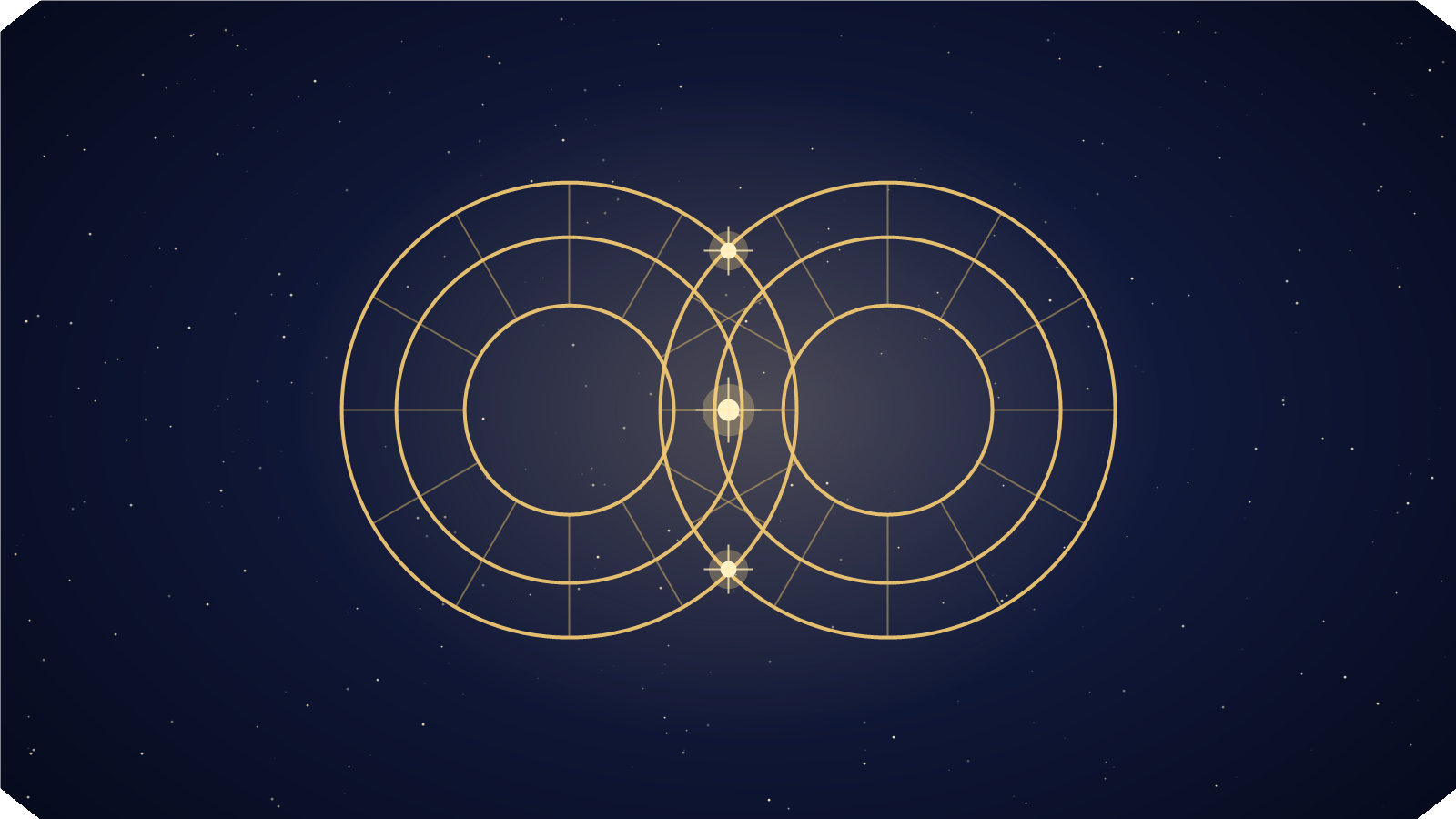
Comparing two zodiac signs by birthday alone rarely explains why a couple finishes each other’s sentences over breakfast yet clashes over holiday plans every winter. In Western astrology, practitioners move beyond broad personality pairings by casting a synastry chart—a bi-wheel diagram that places one person’s natal planets directly around the outside of another person’s birth wheel. Derived from the Greek roots syn- (“together”) and astron (“star”), synastry maps live interaction between two independent people instead of flattening them into one cliché.
Three relationship techniques often get confused in popular astrology. Sun-sign compatibility compares only the seasonal signs of each partner’s Sun, ignoring nine other planets, the rising sign, and all twelve houses. Synastry keeps both charts distinct, measuring inter-chart aspects between Partner A’s and Partner B’s planets while showing which houses each partner activates for the other. A composite chart does something mathematically different: it calculates exact midpoints between matching planetary pairs—Sun with Sun, Moon with Moon, Venus with Venus—producing a third chart that symbolizes the relationship as an entity of its own. If you want a refresher on interpreting a single wheel first, review our guide on how to read your birth chart.
Western synastry uses the tropical zodiac, anchored to the Northern Hemisphere Vernal Equinox (0° Aries) rather than to background star constellations. Due to Earth’s gradual axial precession over roughly 25,772 years, tropical signs sit approximately 23° to 24° ahead of the astronomical constellations and the sidereal Rashis of Vedic Jyotish. Accurate birth times are required for Ascendants, Descendants, and house overlays, whereas inter-chart planetary aspects (aside from exact Moon degrees) remain readable without birth times. For broader relational context, see our overview of zodiac compatibility in love.
Step 1: Assess Each Individual Birth Chart Before Comparing Them
Experienced astrologers follow one firm rule before opening a bi-wheel: interpret Person A’s natal chart alone, then interpret Person B’s chart alone. A synastry aspect cannot manufacture a trait from scratch; it can only stimulate, calm, or stretch patterns already present in each partner’s natal promise. Understanding how Sun, Moon, and Rising signs establish personal temperament gives every two-chart comparison an honest foundation.
Examine four natal anchors in each chart individually before overlaying them:
- The 7th House Cusp (Descendant) and Its Ruler: Opposite the Ascendant, the Descendant reveals what someone seeks—or projects onto—committed partners. Note the sign on the 7th cusp, any planets inside that house, and the placement of its ruling planet. Someone with a Libra Descendant, for example, checks natal Venus to trace how partnership unfolds.
- Natal Venus and Mars Condition: Venus governs affection, shared values, and receptivity, while Mars reflects desire, pursuit, and conflict style. In classical essential dignity, Venus moves smoothly in its domiciles of Taurus and Libra and its exaltation in Pisces, whereas placements in detriment (Aries or Scorpio) or fall (Virgo) show devotion through bolder, protective, or practical habits. Our guide to your Venus sign in astrology explores these nuances further.
- Natal Moon and Mercury Patterns: The Moon indicates how a person decompresses and builds domestic safety. Mercury maps listening habits and disagreement repair—themes detailed in our guide to zodiac sign communication in relationships.
- Tight Natal Outer-Planet Aspects: Check whether natal Venus, Moon, or the 7th-house ruler tightly aspects Saturn, Uranus, Neptune, or Pluto. Someone born with Venus square Uranus naturally values autonomy in every bond; spotting that upfront prevents blaming the partner’s chart for a preexisting personal rhythm.
Secondary chart points—such as the Lunar Nodes, Chiron, Juno, or the Vertex—can enrich a reading later, yet experienced practitioners deliberately hold them back until the core planets and angles are clear. A natal chart’s foundational pillars (Sun, Moon, Mercury, Venus, Mars, Jupiter, Saturn, and the four angles) always determine the load-bearing structure of how someone gives and receives trust.
With both standalone portraits clear, the bi-wheel stops looking like a tangle of colored lines and becomes a practical map of how two distinct temperaments meet.
Step 2: Key Planetary Pairs in a Synastry Bi-Wheel
Inter-chart aspects measure the angular relationship between Partner A’s planets and Partner B’s planets across the five major Ptolemaic angles: conjunction (0°), sextile (60°), square (90°), trine (120°), and opposition (180°). Rather than chasing every minor line on a printout, astrologers prioritize personal planets and Saturn anchors because these govern everyday warmth, conversation, and staying power.
| Planetary Pair | Core Relational Theme | Flowing Aspects (Conjunction, Trine, Sextile) | Dynamic Tension (Square, Opposition) |
|---|---|---|---|
| Sun – Moon | Conscious identity meeting instinctive emotional needs | Mutual warmth, intuitive validation, feeling naturally at home together | Competing priorities between self-expression and comfort; vivid polarity |
| Venus – Mars | Romantic chemistry, aesthetic pull, and erotic pacing | Effortless flirtation, physical ease, matched timing in pursuit | Electric spark paired with mismatched pacing or brief friction |
| Mercury – Mercury | Dialogue flow, humor, planning, and conflict repair | Shared mental shorthand, lively curiosity, smoother logistics | Contrasting problem-solving styles requiring patience and translation |
| Moon – Moon | Domestic routine, stress recovery, and unspoken comfort | Compatible household rhythms, similar rest cues, easy quiet time | Opposite soothing habits—one seeks space while the other wants reassurance |
| Saturn – Personal Planets | Commitment, reliability, boundaries, and durability | Steady loyalty, practical teamwork, dependable backing during stress | Fear of critique or mismatched pacing unless boundaries stay respectful |
| Outer Planets – Personal Planets | Awakening (Uranus), idealism (Neptune), or depth (Pluto) | Fresh inspiration, tender empathy, transformative candor | Sudden disruptions, foggy expectations, or control struggles needing clarity |
Sun–Moon Interaspects: Identity Meets Emotional Instinct
Across centuries of Western astrological practice, Sun–Moon contacts have stood as the hallmark of strong synastry. The Sun signals conscious direction and vitality; the Moon represents instinctive comfort, bodily rhythm, and emotional safety. When Partner A’s Sun forms a conjunction, trine, or sextile to Partner B’s Moon, the Moon partner typically feels steadied and genuinely seen, while the Sun partner feels warmly supported without having to perform. Sun–Moon oppositions frequently appear in enduring partnerships too, working like a Full Moon balance where each partner supplies strengths the other lacks. Sun–Moon squares call for deliberate communication: what energizes the Sun partner can occasionally unsettle the Moon partner’s calm unless both establish clear check-in rituals.
Venus–Mars Dynamics: Attraction, Rhythm, and Pursuit
Venus–Mars contacts illustrate the interplay between receptivity and active desire. Usually, the Venus partner embodies qualities the Mars partner finds magnetic, while the Mars partner’s drive sparks Venus’s enthusiasm. Tight conjunctions and trines tend to produce relaxed physical rapport and mutual appreciation early on. Squares and oppositions between Venus and Mars are renowned for crackling chemistry: slight differences in timing keep curiosity vivid, though open conversations about pacing keep Mars from reading Venus’s deliberation as coolness and keep Venus from feeling hurried by Mars’s urgency. When direct Venus–Mars links are absent, strong Venus–Ascendant or Mars–Descendant contacts often carry similar spark.
Mercury–Mercury and Mercury–Moon Contacts: Everyday Dialogue
Attraction initiates a romance, yet Mercury determines whether two people enjoy navigating household budgets, career shifts, and family logistics years later. Harmonious Mercury–Mercury contacts—especially across compatible temperaments outlined in the four elements in astrology—keep conversation nimble and curious. A supportive Mercury–Moon link is equally priceless because one partner’s phrasing naturally settles the other’s nerves. When Mercury squares or opposes Mercury, friction usually stems from differing speeds rather than ill intent: an Earth Mercury may ask for concrete steps while an Air Mercury brainstorms five hypothetical angles aloud before committing.
Moon–Moon Bonds: Domestic Rhythm and Unspoken Comfort
Sun signs describe how couples interact in public; Moon–Moon links show how they share a kitchen at nine o’clock on a weary weeknight. Moons in the same element or in sextile share instinctive habits around food, downtime, privacy, and emotional venting. Moons in square or opposition often highlight contrasting modalities—the initiating, stabilizing, and adapting instincts examined in Cardinal, Fixed, and Mutable signs. One partner might discharge stress by talking right away, while the other needs forty minutes of quiet first. Naming opposite recovery habits aloud transforms domestic friction into simple logistics.
Saturn Contacts: The Structural Glue of Commitment
Astrologers routinely call Saturn the “glue” of synastry because lasting unions almost always contain at least one tight Saturn aspect to the other partner’s Sun, Moon, Venus, or Ascendant–Descendant axis. Saturn supplies follow-through, shared duty, and the resolve to stay present once initial novelty wears off. Trines and sextiles lend quiet reliability: the personal-planet partner trusts the Saturn partner’s word. Conjunctions, squares, and oppositions carry greater weight. At their finest, they foster serious devotion and real accountability; at their harshest, the Saturn partner drifts into nitpicking while the other feels judged. Mutual respect determines which face emerges.
Uranus, Neptune, and Pluto Contacts: Awakening, Idealism, and Depth
Because outer planets orbit slowly, two peers born within a few years of each other automatically share Uranus–Uranus, Neptune–Neptune, and Pluto–Pluto conjunctions. Those generational overlaps reveal nothing unique about personal romance. Outer planets shape a synastry chart only when Partner A’s Uranus, Neptune, or Pluto makes a tight aspect (typically 1° to 3°) to Partner B’s personal planets or angles. Uranus refreshes stale routines and champions individuality, though sudden shifts can unsettle partners craving steadiness. Neptune deepens empathy, artistic affinity, and romantic wonder, while asking both people to stay anchored in facts rather than idealized projections. Pluto invites fearless honesty and loyalty, paired with a firm requirement to keep jealousy or control patterns off the table.
One additional planetary layer deserves special attention whenever both birth times are verified: personal planets landing within 4° of the other partner’s Ascendant or Descendant. A Sun, Moon, or Venus sitting directly on a partner’s rising degree creates unmistakable visual and physical recognition, often explaining why two strangers feel immediately pulled into conversation across a crowded room before exchanging ten sentences.
Step 3: House Overlays Explained (Where Your Partner Activates Your Life)
While inter-chart aspects describe how two planetary energies interact, house overlays identify where in life that energy lands. Placing Partner A’s planets inside Partner B’s natal wheel shows which domains of Partner B’s life get lit up whenever Partner A walks into the room. Verified birth times are indispensable here since house cusps advance roughly one degree every four minutes. Apply one house system—commonly Whole Sign or Placidus—consistently across both charts.
| House Activated | Life Domain | Typical Relational Experience | Constructive Watch-Out |
|---|---|---|---|
| 1st House | Identity, visibility, physical presence | Immediate recognition; the planet person feels vivid and energizes the house person’s confidence | Maintain independent tastes instead of over-identifying with your partner’s mirror |
| 4th House | Home, roots, private family life | Cozy familiarity, nesting urge, and comfort dropping public armor together | Notice when old childhood household patterns color present disagreements |
| 5th House | Romance, play, creativity, pleasure | Buoyant courtship, humor, shared hobbies, and creative encouragement | Build practical daily routines alongside date-night fun and spontaneity |
| 7th House | Committed partnership, mirroring | Classic relationship magnet; the house person sees an unmistakable equal | Voice needs directly rather than projecting unowned traits onto your partner |
| 8th House | Intimacy, vulnerability, shared resources | Magnetic depth, candid trust-building, and serious talks around shared finances | Keep money agreements explicit and avoid letting intensity breed silent tests |
| 10th House | Public life, ambition, reputation | Visible teamwork, mutual pride, and backing for career or public milestones | Protect unguarded private time so the bond is never reduced to image |
| 12th House | Subconscious, dreams, solitude, empathy | Quiet intuitive resonance, tender care, and sensitivity to unspoken moods | Choose plainspoken honesty so subtle hurt never lingers underground |
House overlays vary sharply in volume. Planets landing in the four angular houses—the 1st, 4th, 7th, and 10th—stand out immediately because they touch the structural pillars of identity, home, committed partnership, and public direction. A partner whose Sun, Moon, or Venus falls in your 7th house feels naturally recognizable as a life counterpart, whereas planets dropping into your 4th house can inspire a lived-in sense of home remarkably fast.
Succedent houses—particularly the 5th and 8th—focus on romance and deep bonding rather than formal structure. A lively 5th-house overlay sustains playfulness and flirtation, while an 8th-house overlay draws couples quickly past surface banter into candid vulnerability and joint financial trust. Meanwhile, the cadent 12th house merits calm nuance. Online clickbait often portrays 12th-house overlays with dread, yet in real practice they regularly show up in deeply compassionate, spiritually attuned couples who sense each other’s hidden fatigue. Refusing to rely on guesswork—and putting delicate emotions into clear words—keeps a 12th-house link restorative instead of confusing.
Checking the house ruler sharpens the picture even further. If Partner A’s Venus lands in Partner B’s 7th house and Aquarius rules that cusp, Partner B will prize Partner A not only for romantic warmth, but also for intellectual comradeship and inventive, pressure-free rituals. Equally reassuring for beginners: having an empty 7th house in synastry never implies a lack of commitment. An unoccupied house simply shows that the relationship flows primarily through other life territories—such as 4th-house domestic warmth, 5th-house shared joy, or 10th-house partnership in public goals—while the 7th house remains active through aspects made to its ruling planet.
Step 4: Reading Harmonious Versus Challenging Synastry Aspects
Many newcomers assume the ideal synastry chart is filled solely with trines (120°) and sextiles (60°), free of any squares or oppositions. In lived practice, an exclusively smooth chart can occasionally feel so effortless that neither partner stretches, initiates fresh growth, or generates enough polarity to keep romantic tension alive—sometimes drifting into pleasant roommate territory.
Squares (90°) and oppositions (180°) introduce constructive voltage. Oppositions create an engaging tug-of-war across complementary themes, inviting each partner to learn from the other’s vantage point. Squares generate lateral motion: differing tempos push couples to negotiate, clarify desires, and stay attentive rather than complacent. Healthy long-term synastry usually pairs energizing friction with dependable stabilizers—such as supportive Moon, Mercury, or Saturn links—that keep arguments safe and repairable. To see how elemental harmony and dynamic contrast behave across familiar combinations, read our overview of the most compatible zodiac sign pairs.
Conjunctions (0°) operate differently from either category. Rather than being inherently easy or hard, a conjunction merges two planetary drives at maximum volume. Venus conjunct Jupiter amplifies warmth, humor, and shared generosity; Mars conjunct Saturn fuses acceleration with caution, calling for patience and coordinated timing so neither partner feels constantly held back or pushed too fast.
Picture a couple whose bi-wheel pairs Moon trine Moon (calm domestic recovery) and Saturn sextile Sun (dependable mutual follow-through) alongside Venus square Mars (spirited romantic tension) and Mercury opposite Jupiter (lively debates over big-picture plans). The flowing contacts form a soft landing pad, while the dynamic angles keep conversations lively and prevent either partner from taking the other for granted.
Tight Orbs and Asymmetric Experience in Two-Chart Comparison
Two technical habits immediately elevate synastry reading from guesswork to genuine clarity: keeping orbs tight and examining the chart from both directions.
An orb indicates how many degrees away from exact geometry an aspect sits. Natal charts frequently allow orbs of 8° to 10° for luminaries, whereas synastry requires noticeably narrower margins because comparing two wheels creates dozens of incidental angles. Most working astrologers limit synastry orbs to 3° to 6° for Sun, Moon, and Ascendant–Descendant aspects, 2° to 5° for Mercury, Venus, and Mars, and 1° to 3° when an outer planet contacts a personal planet. A 1° exact Venus–Mars square is unmistakably palpable in person, while a wide 7° Venus–Mars trine barely whispers. Always rank aspects under 2° first—they carry the loudest everyday signature.
Equally decisive is asymmetric experience. Because synastry places Partner A’s planets into Partner B’s houses—and separately places Partner B’s planets into Partner A’s houses—two people inside the same relationship rarely experience the exact same overlay. Suppose Partner A’s Moon lands squarely in Partner B’s 7th house: Partner B feels emotionally met and drawn toward committed partnership. Flipping the wheel, Partner B’s Saturn might fall in Partner A’s 4th house, making Partner A feel more cautious or duty-bound around domestic choices. Both perceptions are authentic reflections of opposite sides of the bi-wheel.
Checking inter-chart reciprocity—often called a “double whammy”—reveals where both partners share the same wavelength, such as Partner A’s Sun trine Partner B’s Moon alongside Partner B’s Sun sextile Partner A’s Moon. Mutual aspects signal natural symmetry, whereas one-sided overlays mark places where candid check-ins prevent unspoken resentment. In quadrant house systems like Placidus, practitioners also notice when a partner’s planet sits within 1° to 2° of the next house cusp—especially near an angle such as the Descendant or Midheaven—since planets right on a threshold typically blend into the upcoming house’s themes.
Common Synastry Red-Flag Myths Debunked
Online astrology feeds routinely label certain synastry angles as “karmic traps” or “doomed pairings.” Turning symbolic geometry into fatalism distorts Western astrological tradition and sparks needless fear in caring couples. Five persistent myths deserve straightforward correction:
- Myth 1: Saturn squares or oppositions guarantee coldness and heartbreak. Challenging Saturn links test sincerity and highlight tender spots around approval or duty, yet countless multi-decade marriages feature tight Saturn squares to Venus or the Moon. Practiced with warmth and fair boundaries, Saturn friction matures into rock-solid reliability.
- Myth 2: Pluto contacts automatically equal obsession or manipulation. Pluto signifies emotional candor, resilience, and psychological depth. Personal ethics, consent, and self-awareness—not a planetary degree—decide whether Venus–Pluto or Moon–Pluto intensity expresses as fearless trust or unhealthy control.
- Myth 3: Any 12th-house overlay signals hidden betrayal. Classical astrology links the 12th house with unseen spaces, which internet lore oversimplifies into secret enemies. In real couples, 12th-house overlays frequently reflect quiet empathy, creative synergy, and tender intuition—provided both partners communicate plainly instead of dodging difficult talks.
- Myth 4: Missing Venus–Mars aspects mean zero romantic spark. Chemistry flows through many channels, including Sun–Mars, Venus–Ascendant, Mars–Descendant, Venus–Pluto, and vibrant 5th- or 8th-house overlays. Plenty of passionate couples have no direct Venus–Mars angle at all.
- Myth 5: A tense synastry chart means you should walk away. Charts illustrate habits and growth edges; they never issue verdicts. Respectful behavior, kindness, and shared values always outweigh an intimidating aspect grid.
Frequently Asked Questions About Synastry Charts
Can you read a synastry chart accurately if one partner does not know their birth time?
Yes, provided you respect clear limits. Without a verified birth time, that partner’s Ascendant, Descendant, and house cusps remain unknown, so overlays into their houses must be omitted. You can still examine inter-chart planetary aspects among the Sun, Mercury, Venus, Mars, Jupiter, Saturn, and outer planets. Since the Moon moves roughly 12° to 15° daily, a noon chart offers a general Moon-sign estimate, though tight Moon aspects within 1° to 3° require an exact birth time.
What is a “double whammy” in synastry, and why do astrologers look for it?
A double whammy happens when the same planetary pairing appears in both directions—for instance, Partner A’s Venus conjunct Partner B’s Jupiter paired with Partner B’s Venus trine Partner A’s Jupiter. Astrologers prize double whammies because they point to a genuinely reciprocal theme felt clearly by both partners rather than a one-sided impression.
Should couples use Whole Sign or Placidus houses for synastry overlays?
Both systems are respected across Western astrology; choose whichever aligns best with each partner’s natal reading and apply it consistently to both charts. Whole Sign houses assign each full 30° sign to one house beginning at the Rising sign, keeping overlays clean and decisive. Placidus calculates unequal house cusps from time and latitude, accentuating planets near exact angles such as the Ascendant or Midheaven.
How do synastry charts differ from Composite and Davison relationship charts?
Synastry overlays two separate natal wheels to show how Partner A and Partner B affect each other as individuals. A Composite chart averages matching planetary degrees into midpoints, generating one symbolic chart for the couple as a combined unit. A Davison chart finds the exact midpoint in calendar time and geographic coordinates between both births, casting a real-sky chart for that moment. Many astrologers read synastry for interpersonal chemistry first, then consult a Composite or Davison chart for shared long-term purpose.
Why do two people born in the same year share identical outer-planet aspects?
Uranus spends about seven years per sign, Neptune roughly fourteen years, and Pluto twelve to thirty years depending on its orbit. Peers born within a few years of each other naturally share Uranus–Uranus, Neptune–Neptune, and Pluto–Pluto conjunctions. Those generational contacts reflect shared cultural eras rather than personal romance; outer planets matter in synastry only when tightly aspecting the other partner’s personal planets or angles.
Can a strong synastry chart exist between traditionally “incompatible” Sun signs?
Definitely. Couples with square Sun signs—such as a Taurus Sun and an Aquarius Sun—often show deeply supportive synastry across the full bi-wheel. Because Mercury travels within 28° of the Sun and Venus within 48°, adjacent signs frequently bridge the gap directly, while harmonious Moon links, supportive Saturn trines, or welcoming 7th-house overlays easily outweigh a single Sun-sign square.
How does Western tropical synastry compare to Vedic Kundali matching?
Western synastry reads the complete tropical bi-wheel—weighing all ten planets, aspects, and house overlays anchored to seasonal zodiac degrees. Traditional Vedic marriage matching (Ashta Koota or Guna Milan) uses the sidereal zodiac and centers primarily on comparing both partners’ Moon Nakshatras across eight compatibility categories, alongside Manglik (Mars) checks and full natal/Navamsa review by a qualified Jyotish astrologer. Though their astronomical reference frames differ, both traditions serve as reflective tools rather than rigid destinies.
Note on Astrology: Western astrology is a traditional symbolic and cultural framework intended for self-reflection and thoughtful conversation. Synastry readings do not guarantee relationship outcomes and should never replace personal discernment, licensed couples counseling, or professional medical, legal, or financial guidance.