When you open a natal birth chart for the first time, most symbols correspond to tangible objects in our solar system—the Sun, the Moon, and the classical and outer planets. Yet two of the most talked-about glyphs in modern Western astrology—a horseshoe-like arch facing upward and its exact inverted twin positioned directly across the wheel—represent no physical rock, gas giant, or asteroid at all. Known as the North Node and South Node of the Moon, these twin points trace an invisible geometric axis linking familiarity with deliberate growth.
Rather than describing static personality traits, the Lunar Nodes sketch a directional storyline across your life: which instincts feel effortless from early childhood, where autopilot habits can quietly narrow your horizon, and which unfamiliar capacities stretch you toward fuller balance. Exploring them builds naturally on the fundamentals in how to read your birth chart. Throughout this guide, we interpret the nodes within the Western Tropical Zodiac—measured seasonally from the Vernal Equinox—while also clarifying how they relate to astronomical mechanics and the parallel Vedic lineage of Rahu and Ketu.
The Astronomy Behind the Lunar Nodes
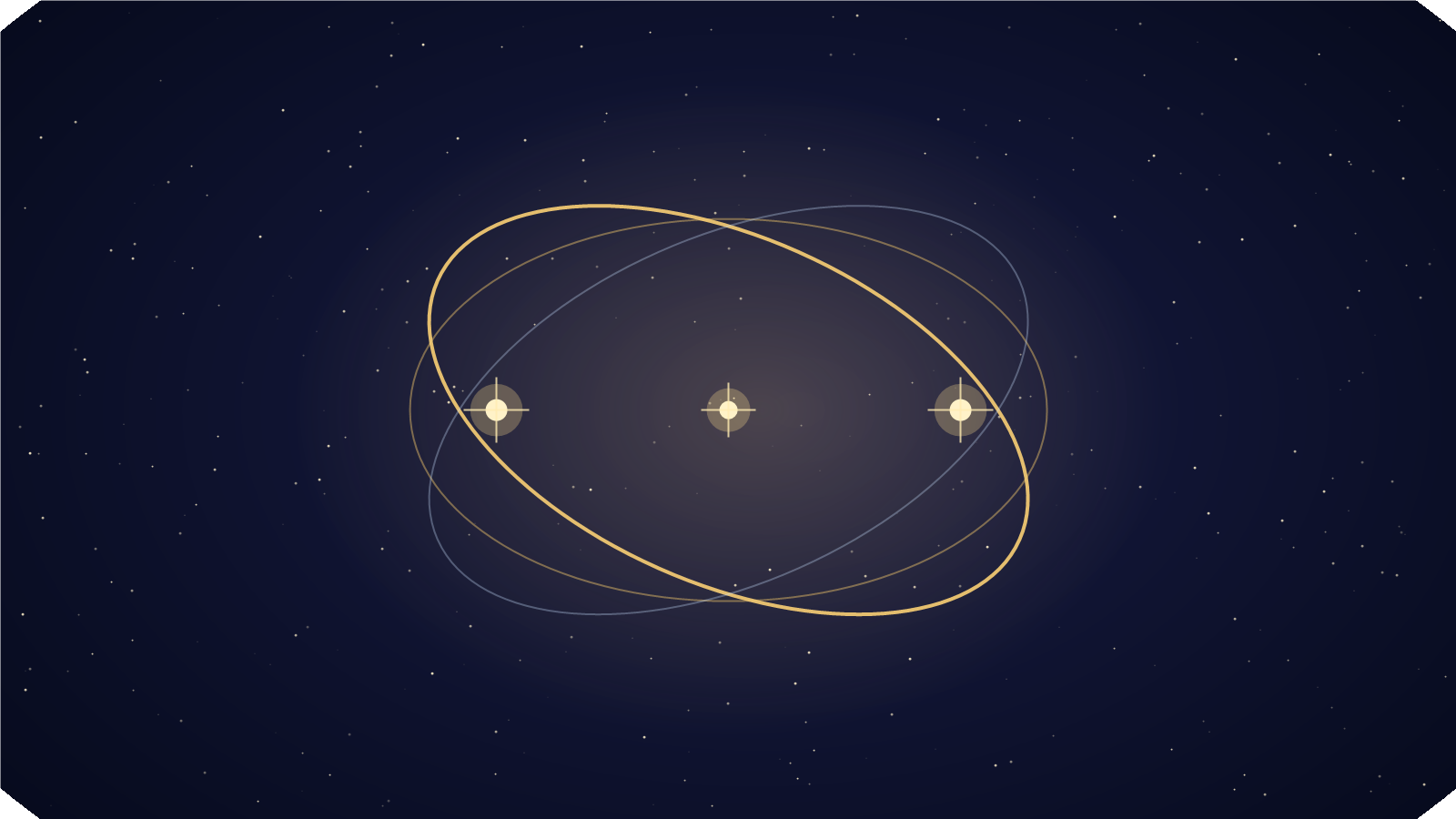
To grasp why ancient astronomers treated the Lunar Nodes with such reverence, picture Earth orbiting the Sun along a flat reference plane called the ecliptic—the apparent annual pathway the Sun traces across our sky. If the Moon orbited Earth along that exact same flat plane, we would witness a solar eclipse at every single New Moon and a lunar eclipse at every single Full Moon. Instead, the Moon’s orbit is tilted by approximately 5.14 degrees (commonly rounded to 5.1°) relative to the ecliptic.
Because of this 5.1° orbital inclination, the Moon spends half of each lunar circuit north of the ecliptic plane and half south of it, crossing the ecliptic twice every draconic month (roughly 27.21 days). The exact mathematical point where the Moon crosses from south to north is the Ascending Node, or North Node—known in medieval Latin texts as Caput Draconis, the “Dragon’s Head.” Positioned precisely 180 degrees opposite sits the Descending Node, or South Node—Cauda Draconis, the “Dragon’s Tail,” where the Moon crosses back from north to south.
This orbital geometry explains the direct bond between the Lunar Nodes and eclipses. Solar and lunar eclipses can occur only when a New Moon or Full Moon takes place close enough to the nodal intersection points—generally within roughly 15° to 18° for solar eclipses and 10° to 12° for lunar eclipses—allowing the Sun, Earth, and Moon to align along a single shadow line. Away from the nodes, the Moon passes too far above or below the ecliptic for shadows to meet. In fact, the word ecliptic itself derives from eclipses, underscoring why astrologers across Babylon, Greece, India, and medieval Europe tracked the Dragon’s Head and Tail with extraordinary precision.
North Node vs. South Node at a Glance
Because the Ascending and Descending Nodes always stand exactly 180 degrees apart, they invariably occupy opposite zodiac signs and opposing natal houses—an architectural pairing explained further in astrology houses explained. Studying one node without its twin misses half the equation. The comparison table below outlines their astronomical, classical Western, modern psychological, and Vedic distinctions side by side.
| Dimension | North Node (Ascending Node) | South Node (Descending Node) |
|---|---|---|
| Astronomical Definition | Mathematical point where the Moon crosses the ecliptic moving south to north. | Mathematical point where the Moon crosses the ecliptic moving north to south. |
| Traditional Latin Name | Caput Draconis (Dragon’s Head). | Cauda Draconis (Dragon’s Tail). |
| Classical Western Function | Increase, amplification, intake, and magnifying whatever planet touches it. | Decrease, release, distillation, and trimming excess from nearby placements. |
| Modern Evolutionary Framing | Unfamiliar growth edge, conscious experimentation, and future-oriented stretch. | Default comfort zone, deeply rehearsed instincts, and inherited coping strategies. |
| Vedic (Jyotish) Counterpart | Rahu—shadow planet (Chaya Graha) of worldly appetite, ambition, and disruption. | Ketu—shadow planet of detachment, past mastery, intuition, and spiritual liberation (moksha). |
| Shadow When Unbalanced | Restless craving, overreaching without grounding, or anxiety in unfamiliar roles. | Stagnation, defensive autopilot, or shrinking back into outgrown routines. |
| Healthy Integration Goal | Practicing new skills steadily while supported by durable inner competence. | Using innate strengths selectively without letting habit dictate every choice. |
Recognizing the Vedic parallel enriches cultural literacy without conflating two distinct systems. In Jyotish, Rahu and Ketu originate in the mythic narrative of the Samudra Manthan (churning of the cosmic ocean), symbolizing the severed head and tail of the celestial being Svarbhanu who briefly swallowed the Sun and Moon. Operating within the Sidereal zodiac—offset roughly 23° to 24° from Western Tropical degrees, as detailed in Tropical vs. Sidereal astrology—Rahu and Ketu carry far more austere, karmic weight in traditional Indian chart reading than the predominantly psychological emphasis of modern Western astrology.
Traditional vs. Modern Evolutionary Interpretations
Astrological interpretations of the Lunar Nodes have evolved markedly over two millennia, and knowing both classical and contemporary viewpoints prevents distorted readings. Hellenistic, Arabic-era, and Renaissance Western astrologers—including Dorotheus of Sidon, Vettius Valens, Abu Ma’shar, Guido Bonatti, and seventeenth-century practitioner William Lilly—rarely described the nodes as a standalone “life purpose” axis. Instead, they treated the nodes primarily as modifiers of planets located near them. The North Node acted as an intensifier or multiplier, increasing the material visibility or output of a conjunct planet, whereas the South Node acted as a reducer, draining worldly excess while occasionally aiding spiritual renunciation or simplifying burdens.
During the twentieth century, psychological and evolutionary astrologers—among them Dane Rudhyar, Martin Schulman, Jan Spiller, and Steven Forrest—recast the nodal axis as a developmental compass. In this modern framework, the South Node represents ingrained defaults: skills you reach for automatically under stress, family patterns absorbed early in life, or symbolic “prior mastery” that feels safe yet can become repetitive if never challenged. The North Node, by contrast, points toward under-exercised qualities that feel awkward at first yet restore vitality, adaptability, and perspective as you mature.
One pervasive pop-astrology myth deserves clear correction: the claim that you must “abandon your South Node completely” to fulfill your North Node. Experienced astrologers consistently push back against that advice. Because the two nodes form a single geometric polarity, rejecting your South Node leaves your North Node unrooted and brittle. Imagine a tall tree attempting to reach wider sunlight by severing its roots—it would topple in the first gust of wind. Real maturity preserves the healthy competence of your South Node while retiring its outdated defensive reflexes, using familiar talents as sturdy scaffolding for North Node exploration.
Context from the rest of your chart also matters enormously. Evaluating the planetary rulers (dispositors) of both nodal signs—explained in planetary rulers and essential dignities—shows which real-world tools help you integrate the axis. Equally decisive are tight natal planetary aspects in astrology: a personal planet sitting right alongside your North or South Node, or squaring both nodes at 90 degrees, personalizes the nodal story far beyond the generational themes shared by everyone born in the same eighteen-month span.
All Six Lunar Nodal Axes Explained
Because the Lunar Nodes remain in one pair of opposite signs for roughly eighteen months, every person shares their nodal sign axis with a wider peer group, while their natal houses reveal the concrete life department where that tension plays out. Below are all six zodiacal nodal polarities, examining both directions of each axis so you can see how the same spectrum flips depending on which end anchors your familiarity and which end invites expansion.
The Aries–Libra Axis: Autonomy vs. Partnership
Linking cardinal fire Aries with cardinal air Libra, this axis weighs direct self-direction against reciprocal alliance. With North Node in Aries and South Node in Libra, your familiar reflex is reading the room, mediating tension, and seeking consensus before acting—skills that foster grace yet risk chronic indecision or quiet resentment when you constantly defer your own desires. Growth arrives through practicing candid initiative, trusting your own instincts without polling everyone first, and bringing your innate diplomacy along as fairness rather than people-pleasing. Flip the axis to North Node in Libra and South Node in Aries, and the default swings toward fierce self-reliance, quick solitary action, and guarding independence tightly. Here, expansion invites deliberate collaboration, active listening, and equitable compromise—discovering that genuine partnership multiplies strength rather than erasing individual identity.
The Taurus–Scorpio Axis: Simplicity vs. Shared Intensity
Pairing fixed earth Taurus with fixed water Scorpio, this polarity navigates calm self-sufficiency alongside deep emotional and material entanglement. With North Node in Taurus and South Node in Scorpio, crisis management, psychological vigilance, and navigating intense alliances feel second nature—yet habitual hyper-alertness can make quiet stability feel suspiciously dull. Stretching toward Taurus means cultivating unhurried sensory presence, clear personal finances, and steady routines while retaining Scorpionic insight without manufacturing drama. Reversed to North Node in Scorpio and South Node in Taurus, comfort rests in predictable possessions, tangible control, and resisting upheaval at all costs. Growth unfolds by releasing rigid attachment to surface security, welcoming honest emotional vulnerability, pooling trust wisely with others, and allowing necessary endings to clear space for renewal.
The Gemini–Sagittarius Axis: Curiosity vs. Conviction
Bridging mutable air Gemini and mutable fire Sagittarius, this axis balances everyday inquiry with sweeping worldview. With North Node in Gemini and South Node in Sagittarius, you instinctively gravitate toward grand philosophies, moral certainty, and broad cultural synthesis—yet relying solely on big-picture assumptions can cause you to talk past nuance or overlook practical local details. Embracing Gemini means asking open-ended questions, listening closely to differing viewpoints, and communicating complex ideas in accessible, everyday language. With North Node in Sagittarius and South Node in Gemini, nimble multitasking, rapid fact-gathering, and witty adaptability come effortlessly, sometimes scattering energy across endless options without committing to a compass. Here, the stretch involves stepping back from constant commentary to distill lived meaning, stand behind principled convictions, and pursue experiences that genuinely widen your horizon.
The Cancer–Capricorn Axis: Nurturance vs. Public Stewardship
Connecting cardinal water Cancer with cardinal earth Capricorn, this axis negotiates private emotional roots alongside outward responsibility. With North Node in Cancer and South Node in Capricorn, stoic competence, self-control, and shouldered duty feel immediately familiar; under stress, you may equate personal worth strictly with productivity while keeping tender needs locked away. Leaning into Cancer asks you to invest sincerely in home life, emotional receptivity, and mutual care—letting your Capricorn organizational skill protect sanctuary rather than turning life into an endless audit. With North Node in Capricorn and South Node in Cancer, protective empathy, family loyalty, and sensitivity to emotional tides form the home base, sometimes leading to over-nurturing others or retreating into familiarity when public accountability beckons. Growth centers on stepping into mature leadership, setting clear structural limits, and translating private compassion into durable public contribution.
The Leo–Aquarius Axis: Creative Heart vs. Collective Vision
Spanning fixed fire Leo and fixed air Aquarius, this polarity explores personal radiance in dialogue with group belonging. With North Node in Leo and South Node in Aquarius, detached observation, egalitarian analysis, and blending smoothly into intellectual circles feel natural—yet hiding behind objectivity can starve personal passion and leave creative gifts unshared. Moving toward Leo encourages warm self-expression, playful risk-taking, and standing visibly behind what you love without waiting for committee approval. Flip to North Node in Aquarius and South Node in Leo, and innate flair, proud individuality, and dramatic magnetism come naturally, though tying self-esteem to center-stage recognition can feel exhausting over time. Expanding into Aquarius invites stepping back to serve wider community goals, welcoming diverse peers as equals, and letting creative warmth fuel collective progress rather than solitary applause.
The Virgo–Pisces Axis: Craft vs. Surrender
Joining mutable earth Virgo with mutable water Pisces, this axis harmonizes practical discernment with imaginative trust. With North Node in Virgo and South Node in Pisces, boundless empathy, artistic intuition, and merging effortlessly with subtle moods come instinctively—yet porous boundaries or vague routines can invite overwhelm and quiet escapism. Practicing Virgo means grounding compassion in reliable schedules, clear analytical standards, and tangible everyday service, turning ethereal sensitivity into dependable craft. Conversely, with North Node in Pisces and South Node in Virgo, meticulous problem-solving, exacting detail work, and constant self-improvement feel comfortable, sometimes tipping into harsh perfectionism and anxiety over uncontrollable variables. Growing toward Pisces involves loosening rigid micromanagement, honoring rest and creative flow, and trusting that imperfect humanity deserves patience alongside practical care.
How Your Natal House Axis Personalizes the Lunar Nodes
Because millions of contemporaries born during the same eighteen-month stretch share your nodal zodiac signs, the natal house polarity provides the decisive personal filter. Always sitting six houses apart across the wheel, your nodal house axis reveals the exact everyday arenas where familiar reflexes meet unfamiliar invitations—regardless of which signs occupy those cusps:
- 1st and 7th Houses (Self vs. Partnership): Balances independent personal agency, physical vitality, and direct self-definition against committed alliances, mutual compromise, and relational reciprocity.
- 2nd and 8th Houses (Personal Assets vs. Shared Resources): Weighs self-earned income, tangible possessions, and simple personal values against joint finances, inheritances, emotional intimacy, and transformative vulnerability.
- 3rd and 9th Houses (Everyday Learning vs. Broad Philosophy): Connects local communication, practical skills, curiosity, and neighborhood ties with higher education, cross-cultural horizons, publishing, and guiding ethics.
- 4th and 10th Houses (Private Roots vs. Public Vocation): Negotiates domestic sanctuary, ancestral heritage, and inner emotional grounding alongside career reputation, public leadership, and visible social responsibility.
- 5th and 11th Houses (Individual Creation vs. Collective Community): Harmonizes romantic play, personal artistry, joy, and self-authored expression with friendships, civic networks, collaborative ideals, and long-range group aims.
- 6th and 12th Houses (Daily Craft vs. Restorative Solitude): Bridges structured work routines, physical wellness, and practical service with quiet reflection, subconscious healing, rest, and spiritual contemplation.
Reading sign and house together brings immediate clarity. Someone with North Node in Aries in the 10th House develops decisive initiative primarily through visible career leadership, whereas someone with North Node in Aries in the 4th House practices that same courageous self-direction by redefining home life and family boundaries. Pairing house arena with sign style turns abstract symbolism into concrete self-observation.
Nodal Returns and Nodal Oppositions: The 18.6-Year Cycle
Unlike the Sun and planets, which advance predominantly counterclockwise (direct) through the zodiacal sequence from Aries toward Taurus, the Lunar Nodes drift predominantly retrograde—moving clockwise backward through the signs (for instance, shifting from Aries back into Pisces). Driven by gravitational torque from the Sun on the Moon’s tilted orbital plane, this steady westward precession carries the nodes across each zodiac sign pair in roughly 18.6 months, completing one full 360-degree revolution every 18.61 Earth years (approximately 6,798 days).
Every ~18.6 years, the transiting Lunar Nodes return to the exact signs and degrees they occupied at your birth—an alignment called a Nodal Return (transiting North Node conjunct natal North Node, South conjunct South). Halfway between returns, roughly every 9.3 years from birth, the nodes invert across your chart in a Nodal Opposition (sometimes called a Reverse Nodal Return), placing the transiting North Node over your natal South Node and the transiting South Node over your natal North Node.
| Nodal Transit Milestone | Approximate Age | Geometric Alignment | Typical Reflective Theme |
|---|---|---|---|
| First Nodal Opposition | ~9.3 years | Nodes inverted (180°) | Early childhood independence shift; contrasting family habits with emerging peer identity. |
| First Nodal Return | ~18.6 years | Nodes aligned (0°) | Threshold of young adulthood; leaving school routines and testing first self-chosen path. |
| Second Nodal Opposition | ~27.9 years | Nodes inverted (180°) | Reassessing early-twenties momentum just as the first Saturn Return window opens. |
| Second Nodal Return | ~37.2 years | Nodes aligned (0°) | Mature course correction; aligning mid-career, relationships, and values with real priorities. |
| Third Nodal Opposition | ~46.5 years | Nodes inverted (180°) | Midlife review of familiar strengths; pruning stale obligations before entering the fifties. |
| Third Nodal Return | ~55.8 years | Nodes aligned (0°) | Seasoned reinvention; preparing purposeful legacy work ahead of the second Saturn Return. |
| Fourth Nodal Opposition | ~65.1 years | Nodes inverted (180°) | Reevaluating daily rhythm, retirement transitions, and community contribution. |
| Fourth Nodal Return | ~74.4 years | Nodes aligned (0°) | Elder distillation; sharing accumulated insight and honoring life’s overarching arc. |
Notice how both turning points carry distinct flavors—and how eclipses falling along your natal nodal signs during those eighteen-month windows act as vivid spotlights. A Nodal Return (ages ~18.6, 37.2, 55.8, and 74.4) tends to feel forward-pulling: an invitation to shed an outgrown chapter and step more boldly toward North Node territory. A Nodal Opposition (ages ~9.3, 27.9, 46.5, and 65.1) often brings familiar people, places, or South Node skills back into view so you can evaluate them with fresher eyes. Intriguingly, your second Nodal Opposition near age 27.9 coincides closely with the opening phase of your first Saturn Return in astrology, reinforcing why the late twenties feel like such an unmistakable crossroads.
Pay special attention to the four to six solar and lunar eclipses that unfold across your nodal sign pair during each return or opposition year. While the slow nodal transit establishes the underlying eighteen-month backdrop, individual eclipses landing within a few degrees of your natal nodes—or aspecting personal planets along that same axis—frequently coincide with abrupt clarity, closed doors, unexpected invitations, and decisive pivots that accelerate long-simmering choices.
Mean Node vs. True Node: Why Chart Calculators Differ Slightly
Anyone who runs their birth details across multiple astrological calculators eventually notices a small toggle labeled Mean Node versus True Node (sometimes called the Osculating Node), with the two figures differing by up to roughly 1°45′ (about 1.75 degrees). This minor discrepancy reflects real celestial mechanics rather than software error. Because solar and terrestrial gravity constantly tug on the Moon’s inclined orbit, the exact intersection points wobble slightly back and forth instead of gliding backward at a mathematically uniform speed.
The True Node measures that instantaneous oscillating intersection at the precise moment of birth; although it moves retrograde roughly eighty-five percent of the time, it briefly stations and travels direct for short stretches whenever the Sun aligns perpendicularly to the nodal axis. The Mean Node calculates the smoothed, averaged retrograde motion—gliding steadily backward at about 3 arcminutes (0.053°) per day. For the vast majority of charts, both calculations place the nodes in the exact same sign and house. Only when your nodes sit within roughly two degrees of a sign or house boundary (0°–2° or 28°–29°) does the choice potentially shift signs, in which case comparing both placements against lived experience offers the clearest verdict.
Frequently Asked Questions About the North Node and South Node
Why do the Lunar Nodes move backward through the zodiac?
Unlike planetary retrogrades such as Mercury Retrograde explained—which are optical illusions caused by Earth overtaking another planet—the Lunar Nodes physically precess westward due to gravitational torque from the Sun acting on the Moon’s tilted orbital plane. Much like a spinning gyroscope whose axis slowly rotates opposite its spin, the orbital intersections genuinely sweep clockwise around the ecliptic every 18.6 years.
Do the Lunar Nodes matter more by zodiac sign or by natal house?
Both work together like actor and stage. The zodiac sign describes the stylistic posture—shared by everyone born during that eighteen-month window—while the natal house axis pinpoints the concrete arena where you experience that pull, such as career versus home or independence versus partnership. Knowing your accurate birth time unlocks the house axis and personalizes the reading dramatically.
What does it mean if a planet sits directly on my North Node or South Node?
A tight conjunction—typically within five to eight degrees—weaves that planet’s archetype directly into your nodal trajectory. A planet conjunct the South Node tends to feel extraordinarily familiar and instinctive from youth, serving as a lifelong skill you must wield mindfully. A planet conjunct the North Node behaves like an amplifier or catalyst, urging active, conscious engagement with that planet’s themes throughout adulthood.
How do the Lunar Nodes operate in relationship synastry charts?
In a synastry chart guide for couples, nodal contacts often explain immediate chemistry. When one partner’s Sun, Moon, Venus, or Ascendant touches the other’s South Node, both people frequently sense uncanny ease and instant recognition. Contacts to the North Node tend to feel galvanizing and future-facing, encouraging mutual growth—though full compatibility always rests on the entire chart and everyday communication.
What are “planets at the bendings” of the Lunar Nodes?
A planet forming a 90-degree square to both the North Node and South Node simultaneously is traditionally said to stand “at the lunar bendings”—corresponding astronomically to the Moon’s maximum northern or southern latitude from the ecliptic. Astrologers view such a planet as a pivotal bridge or turning point whose decisive actions help resolve the tug-of-war between South Node habit and North Node growth.
How do the Lunar Nodes differ from my Sun, Moon, and Rising signs?
Your core triad—covered in Sun, Moon, and Rising signs explained—maps central vitality, emotional temperament, and outward life path. The Lunar Nodes do not replace those foundations; rather, they reveal a developmental gradient cutting across them, showing where your existing personality rests comfortably versus where deliberate curiosity expands your capabilities over decades.
Can my North Node sign change between Western and Vedic astrology charts?
Yes, very frequently. Because Vedic astrology calculates Rahu and Ketu using the Sidereal zodiac—positioned roughly 23° to 24° earlier than Western Tropical zodiac degrees—roughly three-quarters of people discover their Sidereal Rahu and Ketu occupy the zodiac sign preceding their Western North and South Nodes. Each framework remains internally coherent when interpreted using its own traditional principles.
Editorial Perspective: Astrological symbolism—including the Lunar Nodes—is offered here as a historical, cultural, and contemplative lens for personal reflection rather than predictive science. Birth chart placements never dictate fixed destiny and should not replace licensed medical, psychological, financial, or legal counsel.