When beginners first look at a natal chart, they usually start by decoding individual placements: a Sun in one sign, a Moon in another, and a handful of planets scattered across twelve houses. Yet planets in a birth chart never operate in sealed compartments. Just as musicians in an ensemble listen to one another’s tempo, pitch, and volume, the planets interact through precise geometric angles measured along the 360-degree ecliptic. In Western Tropical astrology, these angular relationships are called planetary aspects, and they turn a static inventory of traits into a living, breathing conversation.
Without aspects, a chart reads like a cast list with no script. Knowing that Mercury sits in Virgo while Mars travels through Sagittarius—or that Venus occupies Libra while Saturn rests in Aries—still leaves unanswered whether those drives collaborate smoothly, challenge each other toward growth, or pull in opposing directions at decisive crossroads. Aspects supply the choreography. They explain why two people sharing identical Sun, Moon, and Rising signs still display radically different temperaments, emotional rhythms, and creative trajectories.
The word aspect comes from the Latin aspectus, meaning “gaze,” “sight,” or “looking upon,” which translates the ancient Greek concept of planets witnessing or beholding one another across the zodiac circle. In Hellenistic astrology—codified most famously in the second-century treatise Tetrabiblos by Claudius Ptolemy—geometric intervals determined whether two celestial bodies had a clear line of sight. Today, whether you are learning how to read your birth chart for the first time or comparing charts in relationship astrology, mastering conjunctions, sextiles, squares, trines, and oppositions unlocks the dynamic grammar of the entire wheel.
Master Reference Table: Ptolemaic and Minor Aspects
Western astrology divides aspects into two tiers. The five major (Ptolemaic) aspects divide the 360-degree circle by the simplest whole numbers (1, 2, 3, 4, and 6), echoing classical Pythagorean musical ratios. Centered on clean harmonic symmetry, these five configurations carry the loudest voice in natal, transit, and synastry work. Centuries later, astronomer and astrologer Johannes Kepler expanded this vocabulary in De Fundamentis Astrologiae Certioribus (1601) and Harmonices Mundi (1619), introducing minor aspects derived from additional polygonal divisions such as fifths, eighths, and twelfths.
The reference table below outlines each aspect’s exact geometric angle, typical modern Western orb (the allowable degree cushion around exactness), usual zodiacal relationship, and core functional dynamic.
| Aspect | Category | Exact Angle (Circle Division) | Typical Orb | Usual Sign Relationship | Core Dynamic |
|---|---|---|---|---|---|
| Conjunction | Major (Ptolemaic) | 0° (360° ÷ 1) | 8°–10° (Luminaries); 6°–8° (Planets) | Same sign (occasionally adjacent) | Fusion, concentration, unified intensity |
| Sextile | Major (Ptolemaic) | 60° (360° ÷ 6) | 4°–6° | Two signs apart; compatible elements | Cooperative opportunity requiring initiative |
| Square | Major (Ptolemaic) | 90° (360° ÷ 4) | 6°–8° (up to 9° for Luminaries) | Three signs apart; same modality | Catalytic friction, decisive action, growth |
| Trine | Major (Ptolemaic) | 120° (360° ÷ 3) | 6°–8° (up to 9° for Luminaries) | Four signs apart; same element | Effortless flow, natural synergy, innate talent |
| Opposition | Major (Ptolemaic) | 180° (360° ÷ 2) | 8°–10° (Luminaries); 6°–8° (Planets) | Six signs apart; complementary polarities | Polarity, mirroring, integration of opposites |
| Semi-sextile | Minor (Keplerian) | 30° (360° ÷ 12) | 1°–2° | Adjacent signs (aversion) | Subtle stylistic mismatch, quiet adaptation |
| Semi-square | Minor (Keplerian) | 45° (360° ÷ 8) | 1°–2° | One to two signs apart | Sharp micro-irritation prompting small fixes |
| Quintile | Minor (Keplerian) | 72° (360° ÷ 5) | 1°–2° | Two to three signs apart | Creative ingenuity, specialized craft, invention |
| Sesquiquadrate | Minor (Keplerian) | 135° (3 × 45°) | 1°–2° | Four to five signs apart | Restless pressure pushing latent tension outward |
| Quincunx (Inconjunct) | Minor (Keplerian) | 150° (5 × 30°) | 2°–3° | Five signs apart (aversion) | Ongoing recalibration between unrelated styles |
Notice how the geometry itself mirrors the elemental and modal architecture of the zodiac. Aspects linking planets in the same element behave differently from angles connecting planets of the same modality. Understanding how the four elements in astrology interact alongside cardinal, fixed, and mutable signs makes every degree measurement intuitive rather than something you have to memorize by rote.
Deep Breakdown of the Five Major Ptolemaic Aspects
Although traditional Hellenistic writers technically classified the conjunction as bodily co-presence rather than a visual angle across the wheel, modern Western practice treats all five Ptolemaic configurations as the primary pillars of aspect interpretation. Each carries distinct gifts as well as predictable blind spots.
Conjunction (0°): The Furnace of Fusion
A conjunction occurs when two or more planets occupy virtually the same degree of ecliptic longitude, merging their symbolism into a single compound engine. Rather than alternating turns, conjunct planets fire simultaneously. You cannot easily separate where one planetary impulse ends and the other begins, which makes conjunctions the most concentrated and unmistakable signatures in any horoscope.
Whether a conjunction feels smooth or demanding depends almost entirely on the temperaments and planetary rulers and essential dignities of the bodies involved. Consider a natal Venus–Jupiter conjunction in Taurus: desire, aesthetics, and abundance reinforce each other effortlessly, often producing warmth, artistic generosity, and ease in welcoming pleasure. By contrast, a Moon–Saturn conjunction in Aquarius blends emotional vulnerability with structural discipline, creating someone deeply loyal and composed under crisis who may nonetheless struggle to relax without feeling productive.
- Core strength: Extraordinary focus, unmistakable presence, and the capacity to channel multiple psychological faculties toward one unified purpose.
- Primary watch-out: Blind spots born of subjectivity. Because conjunct planets are fused so tightly, you may assume everyone else experiences that combined urge the same way—or lose perspective when one planet’s needs crowd out the other’s.
Sextile (60°): The Open Doorway
Dividing the zodiac by six places two planets 60 degrees apart—typically two signs away in compatible elements (Fire paired with Air, or Earth paired with Water). Fire and Air feed each other through inspiration and ideas, while Earth and Water nourish each other through practicality and feeling. Unlike the trine, however, the sextile does not operate entirely on autopilot; it behaves like a well-lit invitation that waits for you to step across the threshold.
Take a Mercury in Gemini sextile Mars in Leo. Quick verbal curiosity pairs cleanly with theatrical courage, giving the native a knack for lively debate, confident pitching, or energetic storytelling. Yet that talent blooms most vividly when the person picks up the microphone, writes the essay, or initiates the conversation. Left idle, sextiles stay pleasant dormant assets rather than active achievements.
- Core strength: Collaborative versatility, creative problem-solving, and constructive opportunities that reward small bursts of conscious effort.
- Primary watch-out: Underutilization. Because sextiles generate neither urgent discomfort nor automatic momentum, busy people sometimes overlook the supportive skills sitting right within reach.
Square (90°): The Engine of Action
When two planets stand 90 degrees apart, they usually occupy signs of the exact same modality—Cardinal clashing with Cardinal, Fixed locking horns with Fixed, or Mutable scattering across Mutable—while belonging to incompatible elements. Both planets share a similar tempo of operating, yet they pursue clashing priorities. That cross-pressure generates friction, urgency, and an unmistakable itch to resolve the tension through concrete action.
Popular astrology often paints squares as unfortunate hurdles, yet seasoned astrologers recognize them as the backbone of mastery and resilience. Imagine a Sun in Capricorn squaring Mars in Aries: the Capricorn Sun seeks methodical reputation building, while Aries Mars hungers for immediate, autonomous breakthroughs. Early on, that friction may look like impatience colliding with perfectionism; over time, it forges someone who executes ambitious plans faster and more decisively than peers who never had to align competing inner drives.
- Core strength: Unmatched drive, grit, creative breakthroughs under pressure, and the willingness to confront obstacles head-on instead of avoiding them.
- Primary watch-out: Chronic burnout, defensiveness, or binary thinking that assumes one planet must silence the other rather than building a rhythm that honors both.
Trine (120°): The Circuit of Natural Flow
Separated by 120 degrees—one-third of the zodiac circle—trined planets ordinarily share the exact same element. Fire talks effortlessly to Fire, Earth stabilizes Earth, Air exchanges concepts seamlessly with Air, and Water understands Water intuitively without needing translation. Because there is no elemental friction between the two placements, energy moves along the path of least resistance, manifesting as innate grace, rapid learning, or dependable inner equilibrium.
Consider a Moon in Cancer trine Neptune in Pisces. Emotional receptivity and artistic imagination glide together so naturally that the individual absorbs unspoken moods in a room and translates subtle feelings into music, compassion, or evocative visual design. Still, every smooth circuit carries a quiet caveat: what comes easily is rarely questioned. Someone with abundant trines and few hard aspects may glide through familiar lanes while avoiding unfamiliar risks that would stretch their dormant capabilities.
- Core strength: Authentic ease, protective resilience, graceful synthesis of talents, and genuine enjoyment of the life domains linked by the aspect.
- Primary watch-out: Complacency or passive repetition—assuming a gift will sustain itself indefinitely without intentional refinement, discipline, or external challenge.
Opposition (180°): The Mirror Across the Axis
Standing directly across the zodiac wheel at 180 degrees, opposed planets occupy polar signs that share the same modality and compatible polarity (Fire opposite Air, or Earth opposite Water). Like a seesaw balanced on a central fulcrum, oppositions generate vivid awareness through contrast. Rather than clashing blindly like a square, the two ends of an opposition represent complementary halves of one overarching life theme—self versus partner, privacy versus visibility, detail versus big picture.
Because 180-degree tension feels distinctly externalized, people frequently experience oppositions through partners, collaborators, or rivals—a pattern examined deeply in opposite zodiac signs in love. Someone with Venus in Taurus opposing Pluto in Scorpio, for instance, seeks serene devotion while attracting intense bonds that test trust. Early on, the seesaw may swing between clutching comfort and bracing for upheaval; maturity arrives when both poles hold weight simultaneously, turning projection into lucid self-knowledge.
- Core strength: Panoramic perspective, relational insight, negotiation skill, and the capacity to bridge polarized viewpoints without erasing either side.
- Primary watch-out: Oscillating between extremes or projecting the disowned planet onto partners, bosses, or circumstances instead of claiming both energies internally.
Understanding Minor Aspects: Subtle Angles That Refine the Story
Once you are comfortable reading the five Ptolemaic angles, Johannes Kepler’s minor aspects add high-resolution nuance—especially when they occur within a tight one-to-two-degree orb. Because minor aspects operate more quietly than squares or oppositions, astrologers rarely treat them as headline themes unless they involve the Sun, Moon, Ascendant, or a tightly formed multi-planet configuration.
Quincunx / Inconjunct (150°)
Five signs apart, the 150-degree quincunx connects placements sharing nothing in common—different element, modality, and polarity. Classical Hellenistic astrologers classified this as aversion (apostrophe), noting that turned-away planets lacked a direct line of sight. Modern practice reads the quincunx as ongoing creative recalibration: a Virgo Sun inconjunct an Aquarius Moon constantly bridges hands-on precision with unconventional emotional freedom, yielding inventive routines no single template could predict.
Semi-Sextile (30°)
Connecting adjacent signs—such as Taurus and Gemini or Scorpio and Sagittarius—the 30-degree semi-sextile is the second classical aversion angle. Adjacent signs evolved specifically as corrective pivots away from their predecessors, so planets in semi-sextile operate like neighbors with contrasting household routines sharing a thin wall. The tension is rarely dramatic, yet it produces a steady low-hum awareness that nudges you toward modest, practical coexistence between two mismatched sensibilities.
Semi-Square (45°) and Sesquiquadrate (135°)
Both belonging to the eighth harmonic (multiples of 45 degrees), the semi-square and sesquiquadrate behave like sharp, focused cousins of the 90-degree square. A semi-square often registers internally as a persistent pebble in the shoe—small irritations, minor delays, or nagging restlessness that prompt timely fine-tuning before a larger stalemate develops. Its counterpart, the 135-degree sesquiquadrate (a square plus a semi-square), tends to vent friction outward into visible events, pushing unresolved habits out into the open where they can finally be addressed.
Quintile (72°) and Bi-Quintile (144°)
Dividing the circle by five introduces the quintile (72°) and its double, the bi-quintile (144°). Associated with the golden ratio and fivefold natural symmetry, fifth-harmonic aspects point toward bespoke ingenuity, stylistic mastery, and playful craftsmanship. When Venus forms a tight quintile to Uranus or Mercury, the native often invents an idiosyncratic aesthetic, signature workflow, or witty conceptual blend that feels unmistakably original—a skill honed purely through curiosity and delight in pattern-making.
Orbs, Applying vs. Separating Aspects, and Whole-Sign vs. Degree Geometry
Knowing what a square or trine signifies is only half the skill. Three technical mechanics—orbs, directional motion, and sign-versus-degree boundaries—determine how loudly an aspect speaks and how its timing unfolds across your life.
How Orbs Measure Aspect Intensity
Planets almost never land at an exact mathematical angle such as 90°00′ at the moment of birth. An orb is the allowable margin of degrees on either side of exactness within which two planets still register as aspecting each other. When two bodies sit within the same exact degree number—for example, Mars at 14°12′ Aries and Saturn at 14°48′ Capricorn—astrologers call the aspect partile (exact by degree), and its influence dominates the chart.
Modern Western software defaults typically grant wider orbs of 8° to 10° to conjunctions and oppositions involving the Sun or Moon, 6° to 8° to squares and trines, 4° to 6° to sextiles, and tight 1° to 3° orbs to minor aspects. Medieval traditions used planet-specific moieties—averaging each planet’s individual radius of light (such as 15° for the Sun, 12° for the Moon, and 7° for Venus or Mercury). Under either system, tighter orbs hit noticeably harder than wide ones: a 1-degree Venus–Mars square shapes your Venus sign dynamics and Mars attraction style far more unmistakably than an 8-degree aspect lingering near range’s edge.
Applying vs. Separating Aspects
Every planet moves across the zodiac at a distinct average apparent speed: the Moon races roughly 13 degrees per day, Mercury and Venus shift swiftly around the Sun’s steady 1 degree per day, Mars cruises slower, and Jupiter through Pluto crawl progressively across years and decades. Comparing the faster planet’s trajectory relative to the slower planet reveals whether an aspect is moving toward exactness or receding from it:
- Applying aspects occur when the faster-moving planet is closing the gap toward the exact angle (for instance, Moon at 12° Leo approaching a trine to Jupiter at 15° Sagittarius). Applying aspects feel forward-leaning, anticipatory, and actively unfolding—their lessons tend to gather steam as life progresses.
- Separating aspects occur after exactness has already passed (Moon at 18° Leo moving past its trine to Jupiter at 15° Sagittarius). Separating aspects feel more internalized, reflective, and already woven into your baseline instincts—like wisdom absorbed early in childhood.
Retrograde motion can reverse this direction temporarily. During periods like Mercury retrograde, a faster planet moving backward in apparent longitude can separate from a planet ahead of it or re-apply to a slower planet behind it, adding a distinct revisiting quality to the natal configuration.
Whole-Sign vs. Degree-Based (Out-of-Sign) Aspects
Hellenistic astrology evaluated aspects primarily by whole sign first: any planet in Aries stood in whole-sign square to any planet in Cancer or Capricorn, regardless of whether they sat 2 degrees or 26 degrees apart, with closer degree proximity sharpening the effect. Modern Western psychological astrology, by contrast, measures aspects strictly by exact degree distance across the 360-degree circle.
This degree-first approach allows out-of-sign (dissociate) aspects—such as a Sun at 29° Aries forming a 122-degree degree-based trine to Saturn at 1° Virgo. Because Aries is Fire and Virgo is Earth, that trine lacks the usual elemental harmony of a Fire-to-Fire trine; it still eases cooperation through geometric flow, yet the stylistic translation between spontaneous Fire and analytical Earth requires extra nuance. Checking both sign relationship and exact degree distance gives you the cleanest synthesis of ancient and contemporary technique.
Famous Multi-Planet Aspect Patterns
Individual planetary pairs rarely stay isolated for long. When three or more planets interlock through repeating geometric angles, they form closed shapes—known as aspect patterns or configurations—that act like central power grids across the chart.
Grand Trine
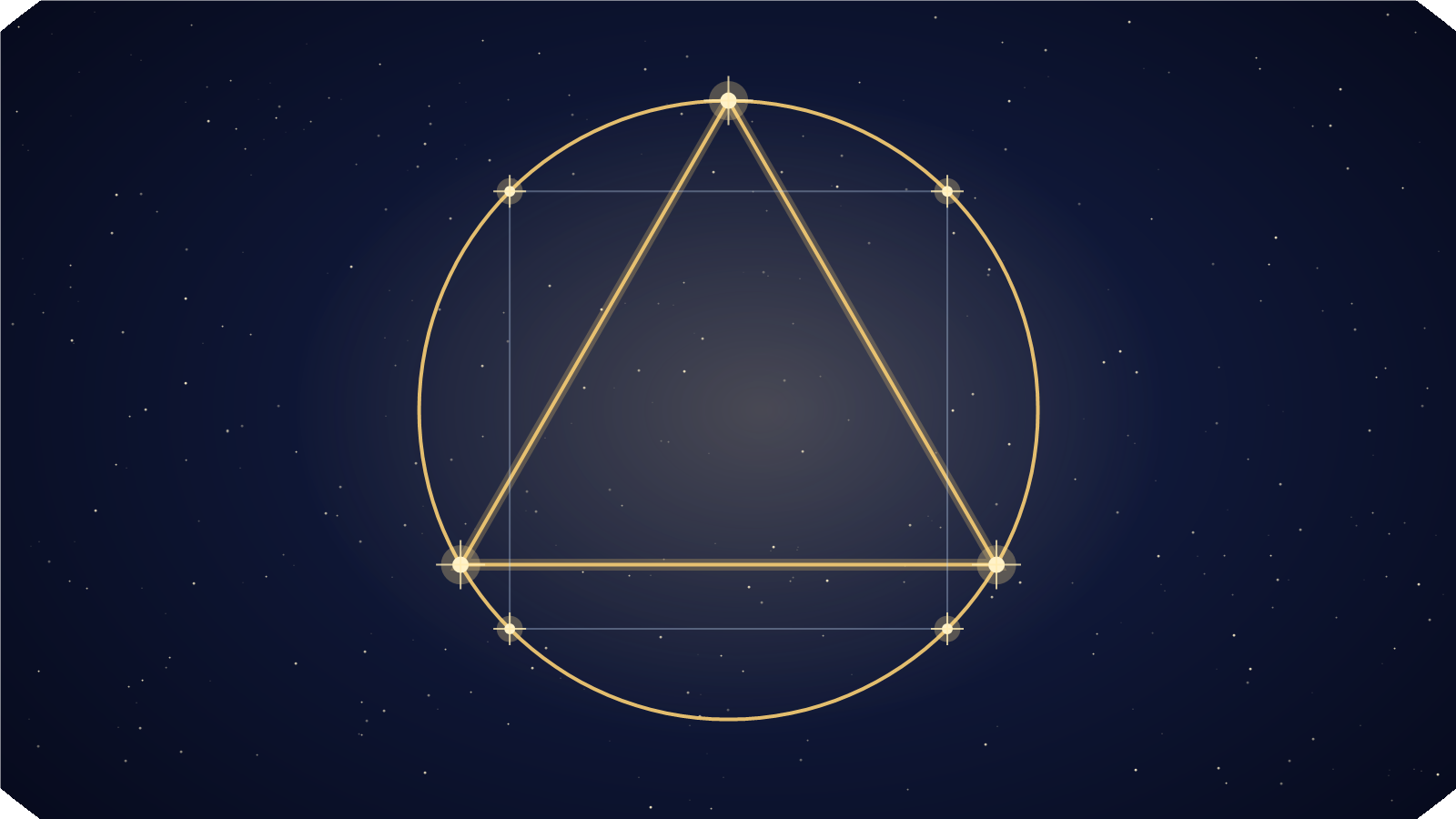
Three planets spaced roughly 120 degrees apart create an equilateral triangle spanning all three signs of one element (Fire, Earth, Air, or Water). Energy circulates smoothly around the triangle like a closed flywheel, producing self-sufficiency and recognizable fluency in that element’s realm. Because the circuit feels so comfortable internally, people with an unchallenged Grand Trine often benefit from external deadlines, ambitious partners, or demanding transits—such as a Saturn return—that motivate them to channel innate ease into tangible output.
T-Square
One of the most recognizable high-achievement patterns, a T-Square links two opposing planets (180°) that both square (90°) a third midpoint planet—the apex. The opposition’s persistent back-and-forth funnels directly into the apex, making its sign and house a lifelong engine of reinvention and output. Astrologers also study the unoccupied degree opposite the apex—the empty leg—as a stabilizing release valve.
Grand Cross
When a fourth planet fills the empty leg of a T-Square, the resulting figure links four placements through two oppositions and four squares across all four signs of a single modality. A Cardinal Grand Cross generates relentless crisis-driven initiative; a Fixed Grand Cross produces monumental endurance alongside stubborn deadlocks; a Mutable Grand Cross fuels dazzling adaptability while testing sustained focus. Though demanding, Grand Cross charts cultivate extraordinary strategic coordination once their owners stop fighting every front simultaneously and learn disciplined sequencing.
Kite
A Kite upgrades a Grand Trine by adding a fourth planet directly opposite (180°) one of the trine points, which automatically forms cooperative sextiles (60°) to the remaining two trine planets. Visually resembling a diamond kite with a central spine, this configuration solves the Grand Trine’s sole vulnerability: the opposition introduces purposeful tension and direction, while the flanking sextiles convert smooth internal talent into focused public impact.
Yod (Finger of God)
Formed when two planets in sextile (60°) both cast tight quincunxes (150°) onto a single apex planet, a Yod creates a narrow, arrow-shaped isosceles triangle pointing squarely at the apex. Because quincunxes connect incompatible elements and modalities, the apex planet often feels like an unusual calling or recurring pivot that defies conventional blueprints. People with a prominent Yod—especially when orbs sit within 2 degrees—frequently experience distinct forks in the road where familiar routines must be dismantled so an unconventional synthesis can emerge.
Stellium
While technically a dense cluster rather than a wide polygon, a stellium—three or more planets concentrated in one zodiac sign or astrological house, often linked by overlapping conjunctions—acts as a gravitational hub. Whenever a transiting planet aspects one body inside the stellium, it triggers a domino chain across the whole cluster, making that arena unusually eventful.
How to Prioritize Aspects Without Getting Overwhelmed
Open a modern chart calculator with every minor aspect and asteroid turned on, and the center of the wheel turns into an unreadable spiderweb of colored lines. Professional astrologers never read every line with equal weight. Instead, they rely on a clean three-filter hierarchy that surfaces the dominant storylines in under two minutes:
- Filter 1 — Start with Luminaries, Angles, and the Chart Ruler: Prioritize major aspects involving your Sun, Moon, Ascendant, Midheaven, and the planetary ruler of your Rising sign. Aspects connecting two outer planets (such as Uranus sextile Neptune) are shared by millions of people born across several years; they only become deeply personal when they lock tightly onto your personal planets or chart angles.
- Filter 2 — Rank by Tightest Orb (Under 2°–3°): Scan your aspect grid for the smallest numbers first. A 0°40′ Mercury–Saturn square will color your communication habits far more audibly than a loose 7°30′ Venus–Jupiter trine. Tight, applying major aspects almost always sit at the top of the chart’s narrative.
- Filter 3 — Look for Repeating Motifs and Hub Planets: Notice which planet receives the most major aspects—or anchors a T-Square, Kite, or Stellium—and watch for echoing signatures. If Mars squares Uranus while also occupying an Aquarius house or receiving an Aquarius decan sub-influence, that unmistakable theme of fierce independence becomes a headline thread rather than a footnote.
This exact same triage works brilliantly when comparing two charts in a synastry chart for couples: tight personal-planet conjunctions, squares, trines, and oppositions tell the real relational story far more clearly than a dozen wide-orb outer-planet echoes.
Frequently Asked Questions About Planetary Aspects
Are squares and oppositions “bad” aspects in a birth chart?
No. Traditional and modern astrologers alike view squares and oppositions as dynamic rather than harmful. While hard aspects generate palpable friction, self-questioning, or competing priorities, they also supply the stamina, realism, and motivation behind major personal breakthroughs. Charts composed almost entirely of soft trines can feel pleasant yet lack the catalytic urgency that pushes talents into public form.
What does an unaspected (or “feral”) planet mean?
A planet forming no major Ptolemaic aspects within standard orbs is called unaspected. Rather than becoming weak, an unaspected planet often operates with striking purity and autonomy because no other planetary voice modulates or negotiates with it. Its expression can feel episodic—quiet in the background for stretches, then unexpectedly dominant whenever transits or relationship charts temporarily wire it into the rest of the horoscope.
Should beginners include minor aspects like quintiles and semi-squares right away?
It is far better to master the five Ptolemaic aspects first. Conjunctions, sextiles, squares, trines, and oppositions account for the overwhelming majority of noticeable natal and transit dynamics. Once you can read those five angles fluidly—and track their orbs and sign relationships—adding tight-orb quincunxes (150°) and quintiles (72°) becomes an illuminating second layer rather than visual clutter.
Do aspects to the Ascendant and Midheaven count as much as planet-to-planet aspects?
Yes—provided you have an accurate birth time. Because the Ascendant and Midheaven shift roughly one degree every four minutes, exact aspects to these angles are uniquely tailored to your exact moment and birthplace. A planet conjunct, squaring, or opposing your Ascendant or Midheaven becomes visibly woven into how others immediately perceive you and how your public trajectory unfolds.
How does a planetary transit aspect differ from a natal aspect?
A natal aspect is a permanent geometric blueprint captured at the moment of birth, describing enduring inner dialogues throughout your life. A transit aspect occurs when a planet moving through the sky right now forms a temporary angle—such as transiting Saturn squaring your natal Moon—activating a specific natal placement for days, weeks, or months before moving onward.
Why do two astrology websites sometimes disagree on whether I have a specific aspect?
Discrepancies almost always trace back to different orb settings. One website might allow a generous 10-degree orb for all Sun aspects, listing a 9-degree Sun–Jupiter trine, while a stricter platform caps trines at 7 degrees and omits it. Others toggle out-of-sign aspects off in favor of whole-sign rules. Checking the exact degree difference yourself settles the ambiguity immediately.
Can an aspect involve the Lunar Nodes, Chiron, or asteroids?
Many modern astrologers read tight aspects (typically within 2°–4°) between personal planets and sensitive points such as the North and South Nodes or Chiron. However, because points like the Lunar Nodes are calculated intersections rather than luminous bodies casting light, classical traditions prioritize conjunctions and oppositions to them over wider minor angles.
Note: Astrology is a traditional cultural and symbolic framework intended for personal reflection and storytelling rather than scientific, medical, legal, or financial prediction.